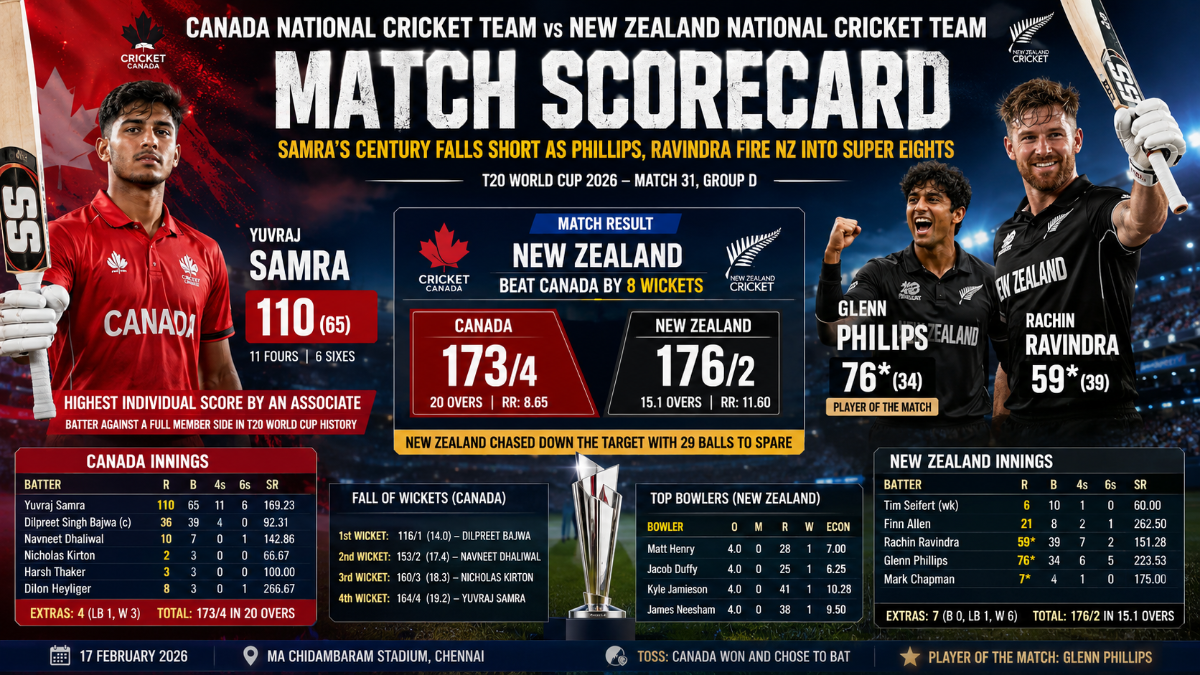
New Zealand chased down 174 in just 15.1 overs to beat Canada by eight wickets in the Canada National Cricket Team vs New Zealand National Cricket Team Match Scorecard from Match 31 of the T20 World Cup 2026, sealing their Super Eight qualification. Even so, the headline of the day belonged to 19-year-old Yuvraj Samra, whose 110 off 65 balls became the highest individual score by an Associate nation batter against a Full Member side in T20 World Cup history. This complete scorecard breakdown covers full batting and bowling figures, fall of wickets, partnership data, and the tactical reasons a genuinely competitive total still wasn’t enough to trouble New Zealand.
Match Result at a Glance
New Zealand beat Canada by 8 wickets in this Group D fixture, played at the MA Chidambaram Stadium, Chennai, on February 17, 2026. Canada posted 173/4 in their 20 overs, and New Zealand overhauled that target at 176/2 in just 15.1 overs, finishing with 29 balls to spare.
| Team | Score | Overs | Result |
| Canada | 173/4 | 20.0 (RR: 8.65) | Lost |
| New Zealand | 176/2 | 15.1 (RR: 11.60) | Won by 8 wickets |
Anyone searching for the NZ vs CAN full scorecard, the Canada New Zealand T20 World Cup 2026 result, or the broader Canada National Cricket Team vs New Zealand National Cricket Team Match Scorecard will find the answer settled early: this was a chase that wobbled for four overs and then turned into pure formality.
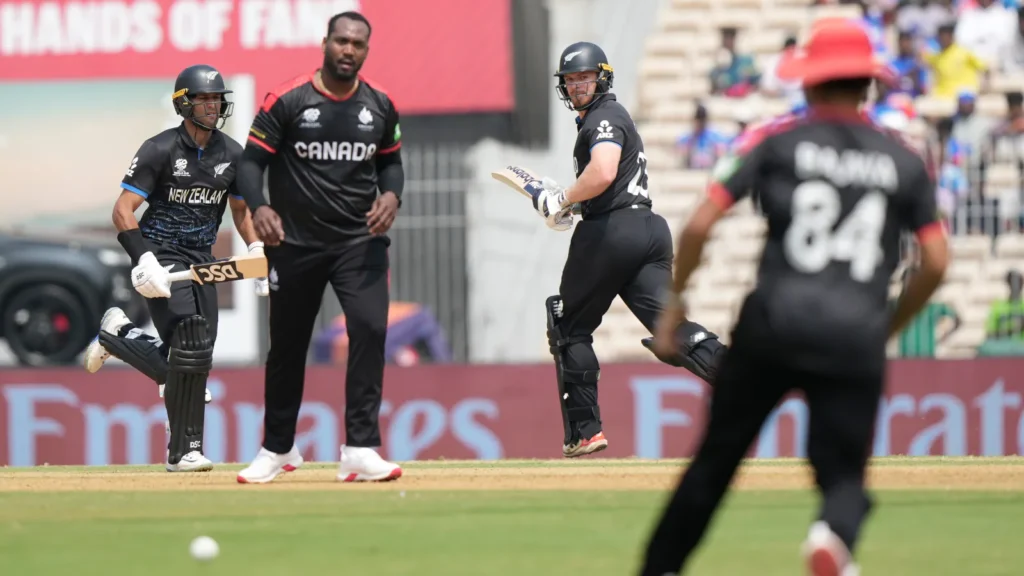
Match Information
- Venue: MA Chidambaram Stadium, Chennai
- Toss: Canada won the toss and chose to bat first
- Player of the Match: Glenn Phillips, for his unbeaten 76
- Match officials: Jayaraman Madanagopal and Sharfuddoula Saikat on-field, Nitin Menon as TV umpire, Andy Pycroft as match referee
- Conditions: Bright and sunny, with short square boundaries that favoured stroke-players throughout the innings
Playing XIs for the Match
Both sides walked into this fixture with slightly altered line-ups, and New Zealand’s changes turned out to matter far more than any preview suggested. The Canada vs New Zealand cricket scorecard for this game reads differently to what most fans expected a week earlier, largely because of two late New Zealand absences.
New Zealand Playing XI
Finn Allen, Tim Seifert (wk), Rachin Ravindra, Glenn Phillips, Mark Chapman, Daryl Mitchell (captain), Cole McConchie, James Neesham, Kyle Jamieson, Matt Henry, Jacob Duffy.
Canada Playing XI
Yuvraj Samra, Dilpreet Singh Bajwa (captain), Navneet Dhaliwal, Harsh Thaker, Nicholas Kirton, Shreyas Movva (wk), Saad Bin Zafar, Shivam Sharma, Dilon Heyliger, Jaskaran Singh Buttar, Ansh Patel.
Read More: Zimbabwe National Cricket Team vs Australia National Cricket Team Match Scorecard
New Zealand fielded a stand-in bowling attack for this game- Lockie Ferguson had flown home for the birth of his first child, and Mitchell Santner was ruled out because of a “dodgy burger.” That forced Cole McConchie and Kyle Jamieson into the XI, thinning out an attack that would otherwise have been considered among the tournament’s strongest.
Canada Innings: Full Batting Scorecard
Canada posted 173/4 in their 20 overs, a total built almost entirely around a record-breaking innings from teenager Yuvraj Samra, who struck 110 off 65 balls before the innings visibly lost momentum in its closing stages.
| Batter | Dismissal | R | B | 4s | 6s | SR |
| Yuvraj Samra | c Glenn Phillips b Jacob Duffy | 110 | 65 | 11 | 6 | 169.23 |
| Dilpreet Singh Bajwa (c) | c Glenn Phillips b Kyle Jamieson | 36 | 39 | 4 | 0 | 92.31 |
| Navneet Dhaliwal | c Glenn Phillips b Matt Henry | 10 | 7 | 0 | 1 | 142.86 |
| Nicholas Kirton | lbw b James Neesham | 2 | 3 | 0 | 0 | 66.67 |
| Harsh Thaker | not out | 3 | 3 | 0 | 0 | 100.00 |
| Dilon Heyliger | not out | 8 | 3 | 0 | 1 | 266.67 |
Extras: 4 (lb 1, w 3). Total: 173/4 in 20 overs
Did not bat: Shreyas Movva (wk), Saad Bin Zafar, Shivam Sharma, Jaskaran Singh Buttar, Ansh Patel.
Canada Fall of Wickets
| Wicket | Score | Over | Batter Out |
| 1st | 116 | 14.0 | Dilpreet Bajwa |
| 2nd | 153 | 17.4 | Navneet Dhaliwal |
| 3rd | 160 | 18.3 | Nicholas Kirton |
| 4th | 164 | 19.2 | Yuvraj Samra |
The most revealing number in this innings isn’t the century- it’s the fall-of-wickets pattern. Canada didn’t lose a wicket until the 14th over, meaning the Samra-Bajwa opening stand alone accounted for 116 runs. But once that partnership broke, Canada could only add 57 runs across the final six overs while losing three more wickets, a stall that turned a potentially match-winning total into a merely respectable one on a ground built for big scores.
Powerplay Breakdown for Canada
Canada raced to 50/0 inside the first six overs, one of the fastest powerplay starts recorded by an Associate team in this World Cup cycle. That early aggression set up everything that followed, giving Samra the platform to accelerate through the middle overs without needing to take unnecessary risks against the new ball.
New Zealand’s Bowling Figures vs Canada
No New Zealand bowler managed more than a single wicket against Canada, a clear symptom of the missing frontline options in their stand-in attack.
| Bowler | O | M | R | W | Econ |
| Matt Henry | 4.0 | 0 | 28 | 1 | 7.00 |
| Jacob Duffy | 4.0 | 0 | 25 | 1 | 6.25 |
| Kyle Jamieson | 4.0 | 0 | 41 | 1 | 10.25 |
| James Neesham | 4.0 | 0 | 38 | 1 | 9.50 |
| Cole McConchie | 3.0 | 0 | 34 | 0 | 11.33 |
| Glenn Phillips | 1.0 | 0 | 6 | 0 | 6.00 |
The combined economy rate across New Zealand’s attack settled at 8.65 runs per over- well above what a title-contending bowling unit would typically permit. Kyle Jamieson, usually a control bowler with his height and bounce, leaked 41 runs from his four overs, underlining how much the absences of Ferguson and Santner reshaped this match before a ball was even bowled.
New Zealand Innings: Full Batting Scorecard
New Zealand’s chase hinged entirely on an unbroken 146-run third-wicket stand between Glenn Phillips and Rachin Ravindra, after both openers fell cheaply inside the first four overs.
| Batter | Dismissal | R | B | 4s | 6s | SR |
| Tim Seifert (wk) | c Jaskaran Singh Buttar b Saad Bin Zafar | 6 | 10 | 1 | 0 | 60.00 |
| Finn Allen | c Shivam Sharma b Dilon Heyliger | 21 | 8 | 2 | 1 | 262.50 |
| Rachin Ravindra | not out | 59 | 39 | 4 | 3 | 151.28 |
| Glenn Phillips | not out | 76 | 36 | 4 | 6 | 211.11 |
Extras: 14 (lb 1, w 11, nb 2). Total: 176/2 in 15.1 overs
Did not bat: Mark Chapman, Daryl Mitchell (c), Cole McConchie, James Neesham, Kyle Jamieson, Matt Henry, Jacob Duffy.
New Zealand Fall of Wickets
| Wicket | Score | Over | Batter Out |
| 1st | 30 | 2.4 | Tim Seifert |
| 2nd | 30 | 3.1 | Finn Allen |
New Zealand slipped to 30/2 inside four overs- on paper, exactly the kind of early pressure that should have rattled a chase against a strong batting line-up. It didn’t, because what followed in the middle overs completely erased any early advantage Canada had built.
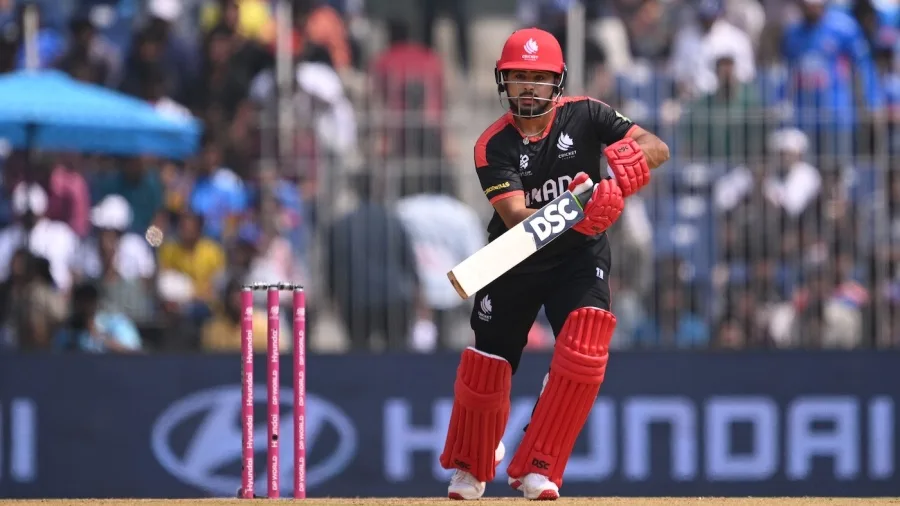
New Zealand Powerplay Breakdown
Despite the two early wickets, New Zealand still finished their powerplay at 60/2, a score that already signalled Canada’s bowling attack lacking the discipline needed to defend a below-300 equivalent total. A powerplay finish of 60/2 against a stand-in top order is not the platform Canada needed to build genuine pressure.
Canada’s Bowling Figures vs New Zealand
| Bowler | O | M | R | W | Econ |
| Jaskaran Singh Buttar | 2.1 | 0 | 31 | 0 | 14.30 |
| Dilon Heyliger | 4.0 | 0 | 42 | 1 | 10.50 |
| Saad Bin Zafar | 3.0 | 1 | 29 | 1 | 9.66 |
| Dilpreet Singh Bajwa | 2.0 | 0 | 26 | 0 | 13.00 |
| Ansh Patel | 2.0 | 0 | 24 | 0 | 12.00 |
| Shivam Sharma | 2.0 | 0 | 23 | 0 | 11.50 |
Why Canada Lost Despite a 173-Run Total
Canada’s 173 became a below-par total because New Zealand’s middle order, led by Phillips and Ravindra, attacked spin aggressively while Canada’s bowlers failed to sustain pressure after the early breakthroughs. Three tactical factors explain the gap between a genuinely competitive total and the eventual eight-wicket margin of defeat.
- No sustained pressure after the early wickets– Buttar leaked 31 runs at an economy of 14.30 in just over two overs, allowing the required rate to stay comfortable even after New Zealand slipped to 30/2
- Spin got hammered rather than used as control– Ansh Patel’s left-arm wrist-spin, intended as Canada’s containment option, was instead targeted relentlessly, with Phillips hitting three sixes off him inside a handful of deliveries
- Canada’s own innings stalled after 14 overs– once the 116-run opening stand ended, the innings managed just 57 runs in the remaining six overs, a sluggish finish on a ground with short square boundaries that should have supported a bigger total
The Bigger Tactical Picture
This match is a textbook example of how a strong top-order total can still lose because of finishing execution. Canada’s batting depth below Samra and Bajwa never got the chance to accelerate freely, while New Zealand’s middle order- even without a settled top three- showed the composure to absorb early pressure and strike back decisively once the field restrictions eased.
Yuvraj Samra’s Record-Breaking Century
Yuvraj Samra’s 110 off 65 balls is the highest individual score by an Associate nation batter against a Full Member team in T20 World Cup history, and his fifty made him the youngest player to reach that landmark in a men’s T20 World Cup match.
Samra survived two dropped chances that extended a genuinely special innings- one missed by Matt Henry when he was on 90 in the 16th over, and another by James Neesham when he reached 103 in the 18th over- before finally being caught by Glenn Phillips off Jacob Duffy in the 20th over. He reached his fifty off 36 balls and his century off 58 balls, striking 11 fours and 6 sixes along the way. It’s the kind of innings that instantly becomes the reference point whenever the Canada National Cricket Team vs New Zealand National Cricket Team Match Scorecard comes up in future record discussions.
The Making of a Prodigy
Born in Brampton, Ontario, to a Punjabi-origin family, Samra was named after Indian all-rounder Yuvraj Singh long before he ever picked up a bat- a mandate from his father, Baljit Samra, who idolised the former India star. He built his game in the Global T20 Canada league and the ICC Cricket World Cup Challenge League, where he emerged as Canada’s leading run-getter during their qualification campaign, long before this Chennai innings turned him into a household name overnight.
Fastest Fifties and Key Milestones
- Samra’s fifty: 36 balls (fastest for Canada in the innings)
- Samra’s century: 58 balls (fastest T20 World Cup century by an Associate batter)
- Phillips’ fifty: 22 balls (fastest of the match, and the innings’ defining moment)
The Phillips-Ravindra Chase: Why the Match Turned
New Zealand’s chase turned decisively between overs 9 and 14, when Glenn Phillips launched a sustained assault on Ansh Patel’s spin, racing to his fifty off just 22 balls and effectively ending the contest as a genuine fight.
- New Zealand reached 60/2 inside the powerplay despite losing both openers early, a sign of middle-order depth Canada’s bowling attack simply couldn’t match
- A 100-run stand between Ravindra and Phillips for the third wicket came up in only 53 balls
- The required run rate never climbed above single digits after the ninth over, removing any real pressure Canada’s remaining bowlers could apply
- Phillips finished unbeaten on 76 off 36 balls at a strike rate of 211.11- the standout individual effort of the entire chase
How the Required Run Rate Evolved
At the fall of the second wicket (30/2 in 3.1 overs), New Zealand needed roughly 9.5 runs per over. By the 11th over, that requirement had dropped to under 7 runs per ball faced, a collapse in required intensity that mirrors how quickly Phillips and Ravindra dismantled any lingering pressure.
Key Records and Numbers From the Match
| Metric | Detail |
| Highest score | Yuvraj Samra- 110 (65) for Canada |
| Fastest fifty | Glenn Phillips- 22 balls |
| Biggest partnership | Ravindra-Phillips- 146 unbroken (3rd wicket) |
| Canada opening stand | Samra-Bajwa- 116 runs |
| NZ powerplay score | 60/2 |
| Canada powerplay score | 50/0 |
| Balls remaining in chase | 29 (4.5 overs) |
Head-to-Head History Between Canada and New Zealand
New Zealand have now won all four international meetings against Canada, and this T20 World Cup fixture was the first time the two sides had ever met in the T20I format. Their previous three encounters all came in ODI World Cups, with New Zealand winning every single one- a pattern that continued in Chennai, extending their unbeaten record over Canada to four matches out of four. This lopsided head-to-head record adds useful context to how emphatically Samra’s century stood out. Even against a side that has never lost to New Zealand, no Canadian batter had previously come close to producing an innings of this magnitude. Canada National Cricket Team vs New Zealand National Cricket Team Match Scorecard
Group D Final Standings After This Result
New Zealand finished Group D with three wins from four matches and six points, securing their Super Eight berth, while Canada finished bottom of the group without a single win.
| Team | Matches | Won | Lost | Points | NRR |
| New Zealand | 4 | 3 | 1 | 6 | +1.227 |
| Canada | 4 | 0 | 4 | 0 | -2.426 |

Canada’s net run rate of -2.426 reflects a group stage in which they were competitive in patches- this match against New Zealand being the clearest example- but couldn’t convert strong individual performances into results. New Zealand, by contrast, carried the momentum from this chase deep into the tournament, eventually reaching the final before losing to India by 96 runs in Ahmedabad.
What This Result Means
New Zealand’s win confirmed their place in the Super Eight stage of the T20 World Cup 2026, a campaign that would ultimately take them all the way to the final. For Canada, Samra’s century remains a genuine building block- proof of emerging talent even inside a heavy defeat- while New Zealand carried fresh evidence into the knockouts that Phillips and Ravindra could shoulder the scoring load whenever frontline bowlers like Ferguson and Santner were unavailable.
Looking Ahead for Both Teams
New Zealand moved into the Super Eight phase with confidence in their batting depth, even with question marks lingering over their bowling attack once Ferguson and Santner returned to full fitness. Canada, meanwhile, exited the group stage with their tournament campaign over, but Samra’s innings gave Cricket Canada a clear individual talent to build a longer-term batting strategy around, and his subsequent performances against the USA and other Associate nations only reinforced that early promise. This match will likely be remembered less for the final margin and more for the individual brilliance packed into it- a teenager’s record-setting century on one side, and a match-defining partnership from two senior New Zealand batters on the other. Anyone revisiting the Canada National Cricket Team vs New Zealand National Cricket Team Match Scorecard years from now will find Samra’s name sitting at the top of it, even in a losing cause, alongside Phillips’ player-of-the-match effort that quietly sealed New Zealand’s Super Eight spot.
Frequently Asked Questions
Who won the Canada vs New Zealand T20 World Cup 2026 match?
New Zealand won by 8 wickets, chasing down Canada’s 173 in 15.1 overs.
What was the toss result in this match?
Canada won the toss and elected to bat first.
Who was named Player of the Match?
Glenn Phillips, for his unbeaten 76 off 36 balls.
What is Yuvraj Samra’s record from this match?
His 110 off 65 balls is the highest score by an Associate nation batter against a Full Member team in T20 World Cup history.
What was the fall of wickets for Canada’s innings?
116/1 (14.0 overs), 153/2 (17.4 overs), 160/3 (18.3 overs), and 164/4 (19.2 overs).
Why were Lockie Ferguson and Mitchell Santner absent for New Zealand?
Ferguson left for the birth of his first child, and Santner was ruled out due to a “dodgy burger.”
What was New Zealand’s Powerplay score during the chase?
60/2 after six overs.
Which bowler took the most wickets for New Zealand?
No bowler took more than one wicket- Henry, Duffy, Jamieson, and Neesham each claimed a single wicket.
How did New Zealand and Canada finish in the Group D standings?
New Zealand finished with three wins from four matches (6 points) to qualify for the Super Eight, while Canada finished bottom with zero wins.
Had Canada and New Zealand ever played each other before this T20 World Cup match?
Yes, they had met three times previously in ODI World Cups, with New Zealand winning all three, this was their first-ever T20I encounter.