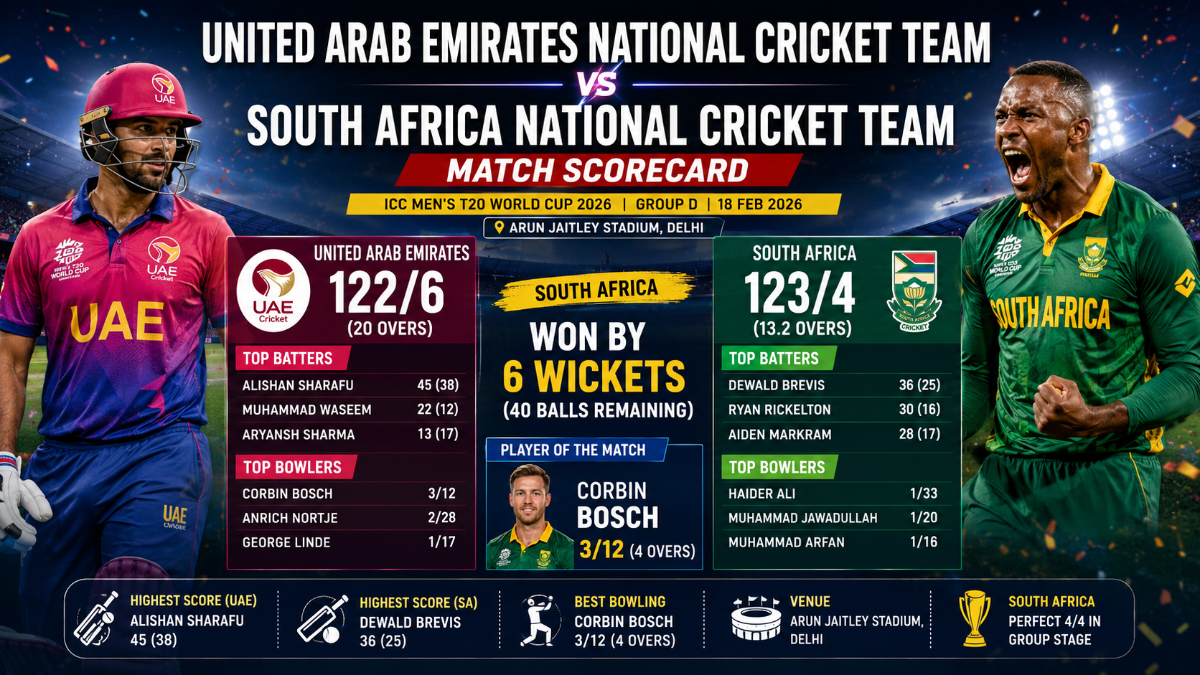
South Africa defeated UAE by six wickets in a one-sided T20 World Cup 2026 encounter, chasing down 122 in just 13.2 overs to complete a perfect group-stage campaign. This United Arab Emirates National Cricket Team vs South Africa National Cricket Team Match Scorecard breakdown covers every batting entry, bowling figure, partnership, and tactical decision that shaped the result at Arun Jaitley Stadium, Delhi, giving fans, fantasy players, and stats-focused readers a complete reference for the fixture.
Quick Match Summary
South Africa beat UAE by six wickets, chasing 122 in 13.2 overs, to finish their T20 World Cup 2026 group stage unbeaten. The result never felt in doubt past the fourth over of South Africa’s reply. UAE’s total of 122 for 6 was always going to be a stretch on a Delhi surface offering true bounce and even carry for pace bowlers, and South Africa’s top order made sure the chase was a formality rather than a contest. This scorecard review of United Arab Emirates National Cricket Team vs South Africa National Cricket Team places every key number inside the tactical context that explains why the margin was so wide. T20 World Cup 2026 scorecards, associate nation performances, or South Africa’s road to the Super Eight, this match offered a clean case study in how top-order intent against an inexperienced attack can neutralize an entire innings before the middle overs even begin.
Match Snapshot
| Detail | Information |
| Fixture | Group D, ICC Men’s T20 World Cup 2026 |
| Venue | Arun Jaitley Stadium, Delhi, India |
| Format | Twenty20 International (T20I) |
| Toss | South Africa won, elected to bowl first |
| Result | South Africa won by 6 wickets (with 40 balls remaining) |
| South Africa Total | 123/4 in 13.2 overs |
| UAE Total | 122/6 in 20 overs |
| South Africa Captain | Aiden Markram |
| UAE Captain | Muhammad Waseem |
UAE Batting Innings: Where the Total Fell Short
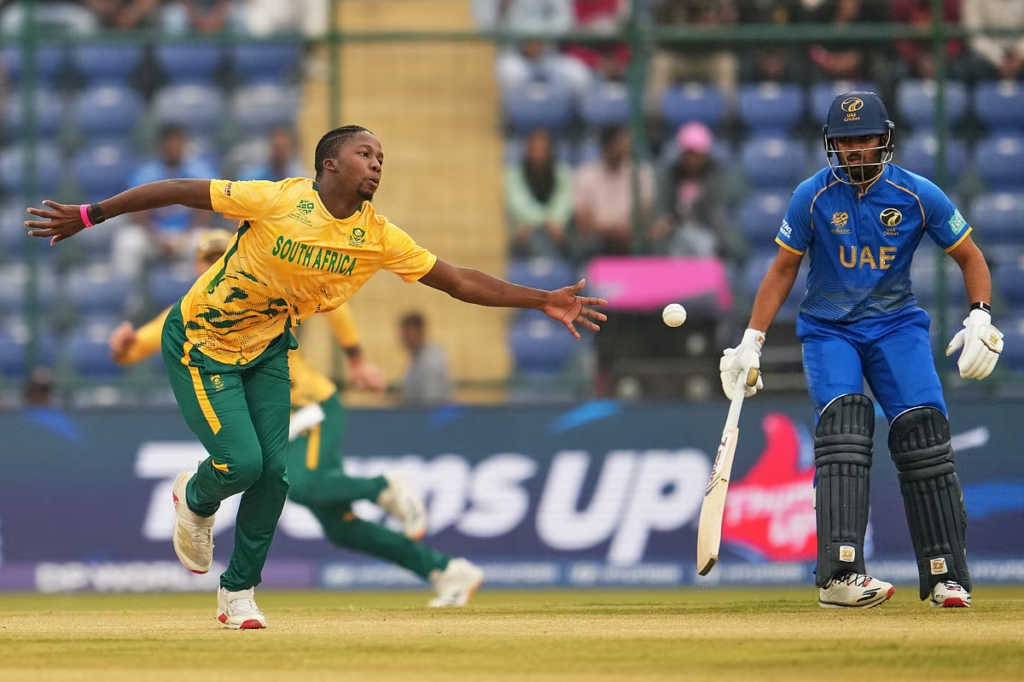
UAE were bowled out for 122 for 6 in their full 20 overs, with only Alishan Sharafu producing a substantial score. UAE’s batting effort had promise in patches but lacked the depth to convert a bright start into a defendable total. Muhammad Waseem, opening and captaining the side, struck 22 off just 12 balls with four boundaries, giving UAE a rapid start inside the power play. That early intent, however, wasn’t sustained once South Africa’s seam bowlers found their lengths and adjusted their fields.
UAE Full Batting Scorecard
| Batter | Dismissal | Runs | Balls | 4s | 6s | Strike Rate |
| Aryansh Sharma (wk) | c Maphaka b Bosch | 13 | 17 | 1 | 1 | 76.47 |
| Muhammad Waseem (c) | lbw b Linde | 22 | 12 | 4 | 0 | 183.33 |
| Alishan Sharafu | c Maphaka b Nortje | 45 | 38 | 5 | 1 | 118.42 |
| Sohaib Khan | c de Kock b Bosch | 6 | 11 | 0 | 0 | 54.55 |
| Muhammad Haider Shah | c Maphaka b Nortje | 6 | 15 | 0 | 0 | 40.00 |
| Muhammad Arfan | c Smith b Bosch | 11 | 18 | 0 | 0 | 61.11 |
| Dhruv Parashar | not out | 5 | 7 | 0 | 0 | 71.43 |
| Muhammad Farooq | not out | 1 | 2 | 0 | 0 | 50.00 |
Top-Order Struggles After a Promising Start
Waseem’s dismissal midway through the powerplay triggered a stretch where UAE lost momentum almost immediately. Aryansh Sharma, batting alongside Waseem at the top, managed only 13 off 17 balls before falling to a well-set fielding trap near the circle’s edge. Sohaib Khan followed for a scratchy 6 off 11, unable to rotate strike against tight lines outside off stump. The pattern was clear: UAE’s top three had the intent, but not the control, to build a platform past 60 or 70 runs without losing wickets.
Sharafu’s Lone Fight
Alishan Sharafu‘s 45 off 38 balls was the standout individual innings of the match, and arguably the only UAE batting performance that matched the occasion. He timed the ball cleanly through the covers and found the boundary rope five times, but the required acceleration in the back half of the innings never materialized. He fell in the 18th over attempting to break the shackles, right when UAE needed him most-a dismissal that effectively ended any lingering hope of pushing the total past 140.
Read More: England Cricket Team vs Nepal National Cricket Team Match Scorecard
Middle and Lower Order Collapse
The middle and lower order-Muhammad Haider Shah, Muhammad Arfan, Dhruv Parashar, and Muhammad Farooq-combined for fewer than 25 runs off nearly 42 balls, a clear indicator of the gap between UAE’s top three and the rest of the batting unit. This imbalance is a recurring theme for associate nations transitioning into top-tier T20 World Cup competition, where the margin for error against disciplined death bowling narrows sharply.
UAE Fall of Wickets
| Wicket | Score | Over | Batter Out |
| 1st | 38 | 4.3 | Muhammad Waseem |
| 2nd | 42 | 5.2 | Aryansh Sharma |
| 3rd | 64 | 9.2 | Sohaib Khan |
| 4th | – | – | Muhammad Haider Shah |
| 5th | 112 | 17.4 | Alishan Sharafu |
| 6th | 119 | 19.2 | Muhammad Arfan |
South Africa’s Bowling Breakdown: Precision Over Pace
Corbin Bosch finished with figures of 3 for 12, the best bowling performance of the match, dismantling UAE’s middle order between overs 9 and 19. South Africa’s bowling plan was built around control rather than raw pace, and it worked precisely as designed. Bosch bowled full and straight, denying UAE’s batters room to free their arms, and picked up three wickets in the middle phase that effectively capped the total well below 140.
South Africa Bowling Figures
| Bowler | Overs | Maidens | Runs | Wickets | Economy |
| Corbin Bosch | 4.0 | 0 | 12 | 3 | 3.00 |
| Anrich Nortje | 4.0 | 0 | 28 | 2 | 7.00 |
| George Linde | 4.0 | 0 | 17 | 1 | 4.25 |
Nortje’s Impact With the New Ball and at the Death
Anrich Nortje picked up two wickets for 28 runs, including the crucial dismissal of Sharafu just as the innings threatened to accelerate. His pace and bounce troubled UAE’s batters throughout, and his final over-bowled with the total already under control-offered no room for a late flourish. Nortje’s role wasn’t about volume of wickets, it was about denying UAE’s most dangerous batter the strike rate he needed in the closing overs.
Linde’s Economical Middle Overs
George Linde’s left-arm spin added another wicket for just 17 runs across four overs, tightening the middle phase when UAE most needed boundary options. Between Bosch, Nortje, and Linde, South Africa’s attack conceded fewer big-over eruptions than UAE would have hoped for heading into the death overs, and that discipline is the single biggest reason the total stalled at 122.
South Africa’s Chase: A Contest Decided in the Powerplay
South Africa chased down 122 in just 13.2 overs, losing only four wickets, effectively ending the match inside the first four overs of their innings. If UAE’s innings had one obvious flaw, South Africa’s reply had one obvious strength: intent from ball one. Aiden Markram, leading the side, top-scored with 28 off just 11 balls, a strike rate above 250 that immediately pushed South Africa well ahead of the required run rate.
South Africa Full Batting Scorecard
| Batter | Dismissal | Runs | Balls | Strike Rate |
| Aiden Markram (c) | bowled b Haider Ali | 28 | 11 | 254.55 |
| Quinton de Kock (wk) | c Haider Shah b Jawadullah | 14 | 16 | 87.50 |
| Ryan Rickelton | c Parashar b Farooq | 30 | 16 | 187.50 |
| Dewald Brevis | dismissed | 36 | 25 | 144.00 |
| Tristan Stubbs | not out | 6 | 7 | 85.71 |
| Jason Smith | not out | 3 | 5 | 60.00 |
Markram’s Powerplay Assault
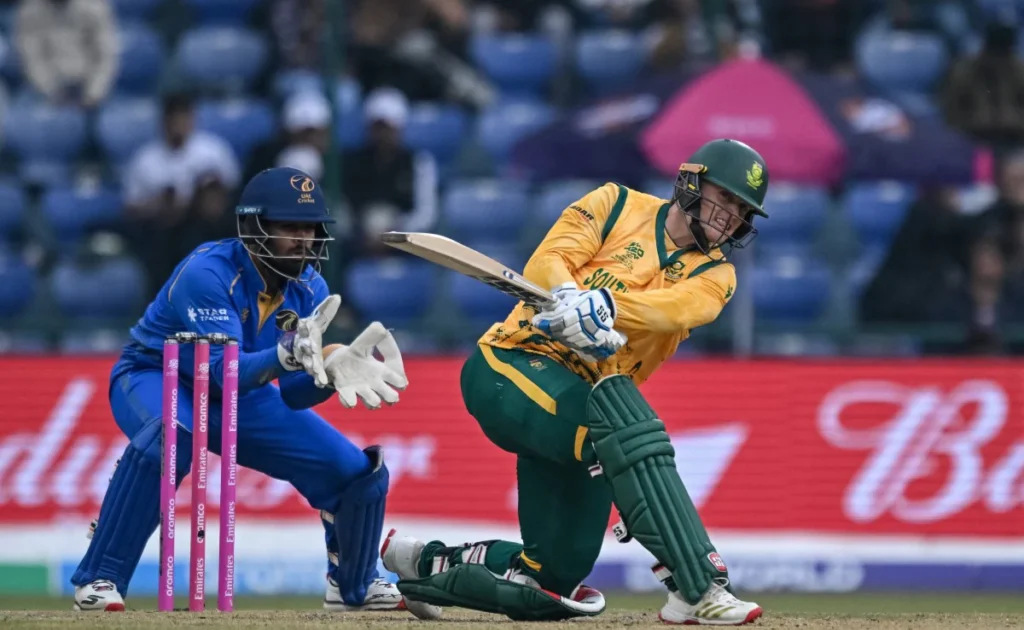
Markram’s innings included five boundaries and a six, and its impact went beyond the raw numbers. By racing to nearly 30 runs before the third over was complete, he removed every ounce of pressure UAE’s bowlers might have hoped to apply. UAE’s attack, built around part-time and inexperienced options, had no answer for that level of intent so early in the chase. This is the single most important stretch of the match-everything South Africa did afterward was simply managing a game that had already been won.
Rickelton and Brevis Seal the Result
Ryan Rickelton followed with 30 off 16 balls, and Dewald Brevis added 36 off 25, the two innings combining to strip away any lingering hope UAE had of a comeback. By the time Tristan Stubbs and Jason Smith walked out to finish the chase unbeaten, South Africa were cruising with more than six full overs still in hand.
UAE Bowling Figures
| Bowler | Overs | Runs | Wickets | Economy |
| Dhruv Parashar | 2.0 | 8 | 0 | 4.00 |
| Junaid Siddique | 2.2 | 23 | 0 | 9.85 |
| Haider Ali | 3.0 | 33 | 1 | 11.00 |
| Muhammad Jawadullah | 2.0 | 20 | 1 | 10.00 |
| Muhammad Arfan | 2.0 | 16 | 1 | 8.00 |
| Muhammad Farooq | 2.0 | 19 | 1 | 9.50 |
No UAE bowler managed an economy rate below 4.00 apart from Parashar, underlining just how little control the attack had once Markram set the tone.
Turning Point of the Match
The contest effectively turned in the third over of South Africa’s chase, when Markram’s assault pushed the required rate below manageable levels for UAE’s bowling attack. While Sharafu’s dismissal in UAE’s innings capped their total, the real turning point came once South Africa began batting. Markram‘s approach signaled intent that UAE’s bowlers, several playing their first T20 World Cup fixture, simply weren’t equipped to counter. Once the required rate dropped under six an over inside the powerplay, the outcome was effectively settled, and every subsequent over was about managing risk rather than chasing a target.
Three Reasons South Africa Won This Contest
- Powerplay dominance: Markram’s strike rate above 250 removed all chase pressure before the fourth over.
- Death-overs bowling discipline: Bosch’s 3 for 12 prevented UAE’s middle order from pushing past a defendable total.
- Squad depth and rotation: South Africa rested several frontline players and still won comfortably, underlining bench strength ahead of the knockout stage.
Playing XIs and Team Selection Context
South Africa made multiple changes to their squad for this fixture, having already secured qualification, opting to manage workload ahead of tougher assignments in the Super Eight stage. UAE fielded their strongest available combination, built around top-order aggression and a young, largely uncapped bowling attack still gaining experience at this level.
Read Also: India National Under-19 Cricket Team vs South Africa National Under-19 Cricket Team Timeline
Playing XIs
| South Africa | UAE |
| Aiden Markram (c) | Muhammad Waseem (c) |
| Quinton de Kock (wk) | Aryansh Sharma (wk) |
| Ryan Rickelton | Alishan Sharafu |
| Dewald Brevis | Sohaib Khan |
| Tristan Stubbs | Muhammad Haider Shah |
| Jason Smith | Muhammad Arfan |
| George Linde | Dhruv Parashar |
| Corbin Bosch | Muhammad Farooq |
| Kagiso Rabada | Haider Ali |
| Anrich Nortje | Junaid Siddique |
| Kwena Maphaka | Muhammad Jawadullah |
This selection context matters for anyone studying the United Arab Emirates National Cricket Team vs South Africa National Cricket Team Match Scorecard in detail-South Africa’s margin of victory looks even more comprehensive when accounting for the fact that several first-choice players didn’t take the field.
Powerplay and Death Overs Comparison
A side-by-side look at how each team managed the two most pressure-heavy phases of a T20 innings tells the real story of this match.
| Phase | UAE Batting | South Africa Batting |
| Powerplay (overs 1-6) | Steady start led by Waseem’s 22, but lost momentum by over 5 | Explosive, driven by Markram’s 28 off 11 |
| Middle overs (7-15) | Sharafu anchored, but scoring rate dropped sharply | Chase effectively over, Rickelton and Brevis consolidated |
| Death overs (16-20) | Lost 2 wickets in the final 5 overs, failed to accelerate | Not applicable-chase completed by over 14 |
UAE’s power play intent wasn’t backed up by middle-overs control, while South Africa’s power play intent was never allowed to fade.
Key Stats and Records From the Match
- South Africa completed their group stage with a perfect record, losing zero matches across the tournament.
- Corbin Bosch’s 3 for 12 stands as one of the most economical bowling spells recorded against UAE in this T20 World Cup cycle.
- Alishan Sharafu’s 45 remains one of UAE’s highest individual scores against a top-ranked opponent in this tournament.
- Markram’s strike rate of over 250 in the powerplay ranks among the fastest starts by a South African captain in T20 World Cup play.
- South Africa’s bowling attack conceded just 57 runs across their three specialist bowlers combined, an economy rate under 5 an over collectively.
Why This Result Matters Beyond the Score line
For South Africa, an unbeaten group stage builds momentum and confidence heading into tougher opposition in the knockout rounds, while also allowing coaching staff to test bench options under real match pressure. Resting frontline names and still winning by six wickets sends a message about depth that matters heading into a tournament’s most demanding stage.
For UAE, the tournament run ends at the group stage, but Sharafu’s innings and Waseem’s early intent offer genuine building blocks. The gap that decided this match wasn’t talent at the top of the order-it was depth, both in batting and bowling, across the full XI. Associate nations like UAE continue to close the skill gap with top-tier sides, but matches like this expose where the difference still lies: finishing power in the middle order and death-bowling execution under pressure. As global cricket schedules expand associate-nation exposure to major tournaments, performances like Sharafu’s 45 become important markers of progress even inside a lopsided result. The next step for UAE’s cricket development lies in strengthening their middle-order depth and giving their death bowlers more high-pressure match exposure at franchise and domestic levels.
What This Means for South Africa’s Super Eight Campaign
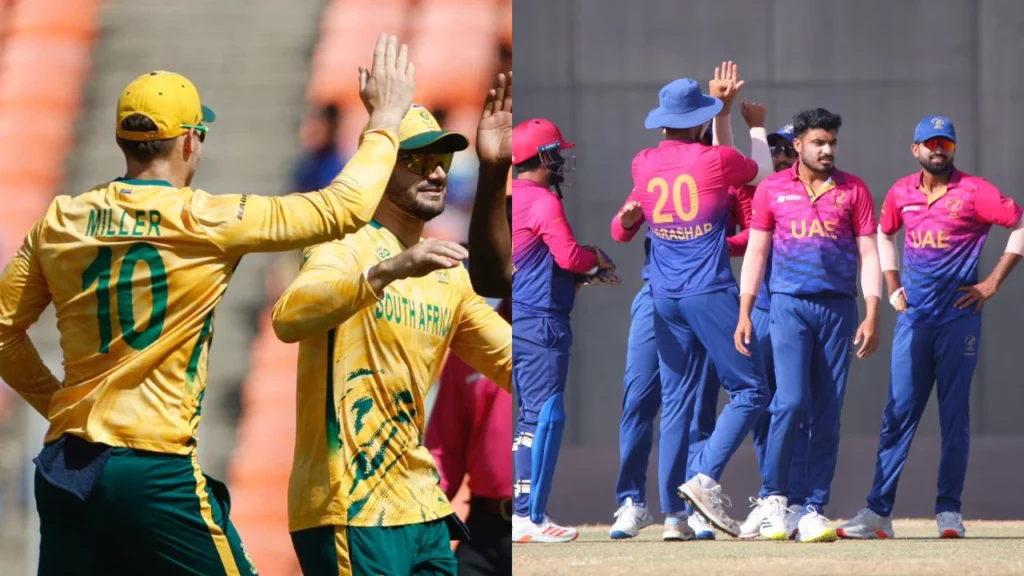
United Arab Emirates National Cricket Team vs South Africa National Cricket Team Match Scorecard, South Africa go into the knockout stage with momentum, tactical clarity on their best XI, and confirmation that their bench options-Bosch, Linde, Nortje, and Smith among them-can deliver under pressure when needed. That flexibility could prove decisive in a format where fitness, form, and matchups shift rapidly across a compressed schedule.
Frequently Asked Questions:
Who won the UAE vs South Africa match in the T20 World Cup 2026?
South Africa won by six wickets, chasing down UAE’s total of 122 in 13.2 overs.
Who was the top scorer in the UAE vs South Africa match?
Alishan Sharafu top-scored for UAE with 45 off 38 balls, Dewald Brevis was South Africa’s top scorer with 36 off 25.
Who took the most wickets in this match?
Corbin Bosch was the standout bowler, finishing with figures of 3 for 12 from four overs.
How many overs did South Africa take to win?
South Africa completed the chase in just 13.2 overs, winning with more than six overs to spare.
Did South Africa lose any matches in the group stage?
No, South Africa finished the group stage with a perfect unbeaten record.
What was UAE’s final score in this match?
UAE were bowled out for 122 for 6 in their full 20 overs.
Who captained South Africa and UAE in this match?
Aiden Markram captained South Africa, while Muhammad Waseem led the UAE side.
Where was the UAE vs South Africa match played?
The match was played at Arun Jaitley Stadium in Delhi, India.
Did South Africa rest key players for this fixture?
Yes, several frontline South African players were rested after the team had already secured qualification.
What does this result mean for UAE’s tournament campaign?
UAE’s tournament ends at the group stage, though performances like Sharafu’s knock indicate promising individual growth against top-tier opposition.
What was the economy rate of South Africa’s bowlers in this match?
South Africa’s three bowlers-Bosch, Nortje, and Linde-combined for an economy rate under 5 runs per over across their 12 overs.
How did the powerplay affect the outcome of the chase?
Markram’s 28 off 11 balls in the power play pushed the required rate down sharply, effectively deciding the match before the fifth over.