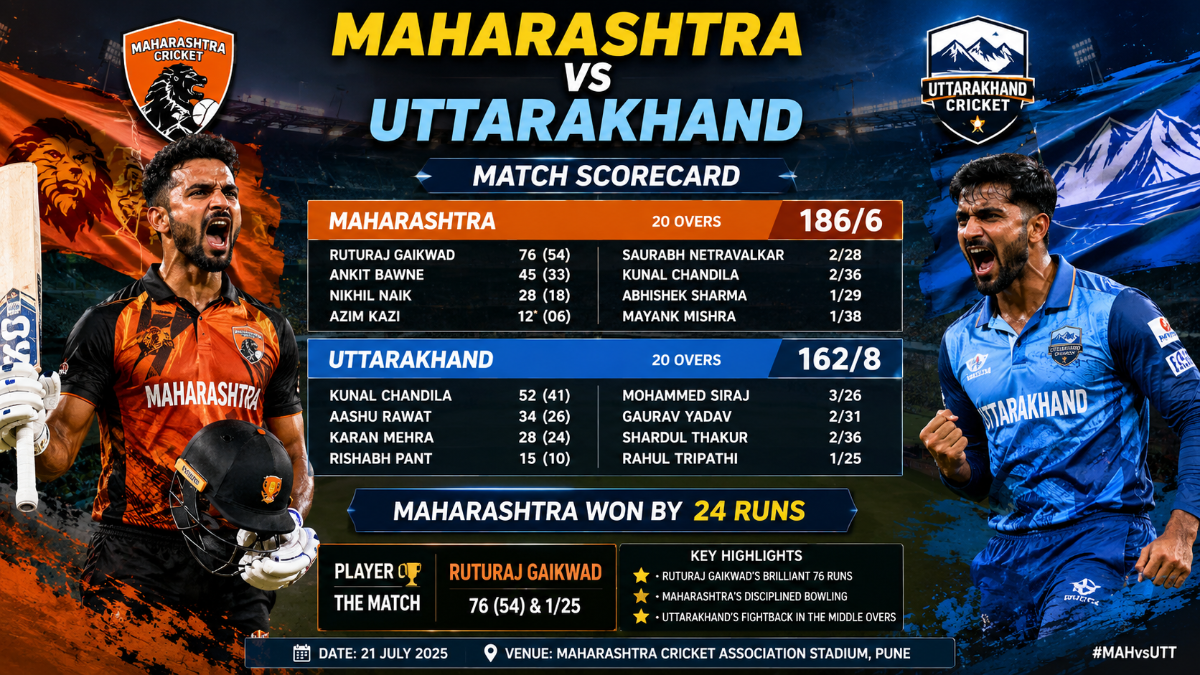
Maharashtra defeated Uttarakhand by 129 runs in Match 72 of the Vijay Hazare Trophy 2025-26, Elite Group C, played on December 31, 2025, at Anantam Ground in Jaipur. Maharashtra posted a commanding 331/7 in their full 50 overs, and Uttarakhand were bowled out for 202 in 43.4 overs while chasing, sealing one of the most decisive results of this Group C campaign. This Maharashtra Cricket Team vs Uttarakhand Cricket Team match scorecard isn’t just a story of one team outscoring another-it’s a case study in how a top-order collapse can still end in a dominant total when the middle order steps up, and how a competitive-looking position at 179/7 in a chase can still collapse under required-run-rate pressure. Domestic List A cricket in India regularly produces these swings, and this fixture is a textbook example.
Match Summary Table
| Detail | Information |
| Result | Maharashtra won by 129 runs |
| Competition | Vijay Hazare Trophy 2025-26, Elite Group C, Match 72 |
| Venue | Anantam Ground, Jaipur |
| Date | December 31, 2025 |
| Toss | Uttarakhand won, elected to field first |
| Maharashtra total | 331/7 (50 overs) |
| Uttarakhand total | 202 all out (43.4 overs) |
| Uttarakhand run rate | 4.63 |
| Top scorer | Ruturaj Gaikwad, 124 off 113 balls |
| Best bowling figures | Devendra Singh Bora, 3/81 |
Maharashtra Batting Scorecard: How The Innings Unfolded
Maharashtra’s innings can be read in three distinct chapters-an early collapse, a patient rebuild, and an explosive finish. Understanding this shape matters more than just reading the final total, because it explains why 331 felt like a fighting score rather than a comfortable cruise.
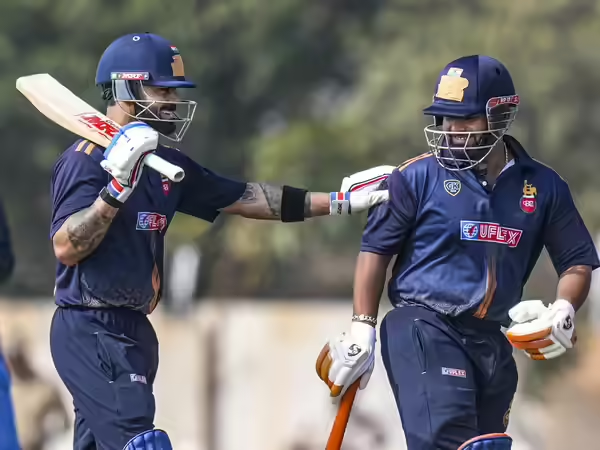
Maharashtra Batting Details
| Batter | Dismissal Context | Contribution |
| Arshin Kulkarni | Dismissed 4th over | 13 runs |
| Siddhesh Veer | Dismissed 9th over | 12 runs |
| Ankit Bawne | Dismissed early | Fell inside first 10 overs |
| Ruturaj Gaikwad (c) | Anchored the innings | 124 off 113 balls |
| Rahul Tripathi | Rebuilt alongside Gaikwad | Departed around 23rd over |
| Satyajeet Bachhav | Middle-overs acceleration | 56 off 45 balls |
The Top-Order Stumble
Maharashtra’s top three fell inside the first ten overs, leaving the side at a precarious 50/3-Kulkarni for 13, Veer for 12, and Bawne shortly after. Uttarakhand’s decision to bowl first, backed by disciplined new-ball bowling in foggy early-morning conditions typical of Jaipur winters, looked like it might dictate the entire match. Losing three wickets inside the powerplay against a fielding-first strategy is precisely the outcome opposing captains dream of, and for a stretch of nearly ten overs, Uttarakhand controlled the tempo completely.
Gaikwad-Tripathi Rebuild The Innings
What followed was a lesson in patient batting under pressure. Gaikwad and Tripathi steadied Maharashtra to 92/3 by the 21st over, deliberately absorbing dot balls and rejecting risky strokes to see off the movement in the pitch. Tripathi’s departure around the 100-run mark in the 23rd over could easily have triggered another slide, but by that stage, the innings had already shifted from survival mode into platform-building mode.
Read More: Sikkim Cricket Team vs Mumbai Cricket Team Match Scorecard
Bachhav’s Match-Defining Cameo
Satyajeet Bachhav’s 56 off just 45 balls is the single most important statistic in this innings that most match reports overlook. Arriving during the fifth-wicket stand, Bachhav’s strike rate of over 120 in the middle overs pushed Maharashtra from a modest position toward 209 and beyond, fundamentally altering the complexion of the innings. Without that acceleration, Maharashtra likely finishes closer to 270-280-a total Uttarakhand’s batting depth could plausibly have chased down. Instead, the extra 50-plus runs Bachhav’s innings generated became the difference between a tight finish and a 129-run rout. Gaikwad’s century-his second List A hundred of the season according to reports from the tournament-was built on this platform, allowing him to accelerate freely in the death overs once the innings had stabilized. A captain scoring a hundred while batting through a top-order collapse is one of the clearest signs of tournament form, and it’s this kind of individual excellence layered on top of team recovery that decides knockout qualification races in group-stage cricket.
Maharashtra Bowling Scorecard And Field Restrictions
Maharashtra’s bowling attack, while less discussed than the batting heroics, played an equally decisive role in preventing Uttarakhand’s chase from ever gaining full control. Tight lines through the middle overs of the chase meant Uttarakhand’s required run rate kept climbing even during periods where they weren’t losing wickets-a subtle form of pressure that eventually forced risky shots and the late-innings collapse.
Middle-Overs Control
Bowling economy between overs 20 and 40 typically decides the outcome of 50-over chases, and Maharashtra’s discipline in this phase prevented Uttarakhand from ever building the acceleration needed against a 332-run target. This is the kind of tactical detail a plain scorecard misses entirely-the story isn’t just about wickets taken, but about dot-ball pressure applied consistently enough that Uttarakhand’s batters were forced into low-percentage shots later in the innings.
Uttarakhand Batting Scorecard: A Chase That Fell Apart Late
Chasing 332 for victory always demanded a substantial partnership or two, and Uttarakhand’s batting effort, while not without merit, ultimately fell well short of the mark.
Uttarakhand Batting Details
| Batter | Runs | Balls | Strike Rate Context |
| Mayank Mishra | 30 | 44 | Top scorer during the middle stretch |
| Saurabh Rawat | 34 | 54 | Anchored briefly before the collapse |
| Remaining batters | Combined for balance of 202 | – | Collapse from 179/7 |
Uttarakhand actually reached a respectable 179/7 deep into their innings, a position that-on paper-still left the chase mathematically alive. But List A cricket rarely rewards teams that fall behind the required run rate with fewer than five wickets in hand, and Uttarakhand’s final three wickets fell in a hurry, taking the side from 179/7 to all out for 202 in 43.4 overs.
Why The Chase Collapsed Late
The gap between 179/7 and 202 all out tells its own story-Uttarakhand lost their last three wickets while adding just 23 runs, a clear sign that the required run rate pressure had compounded into desperation in cricket. Once the asking rate climbs above 8 runs per over with only the tail remaining, recoveries become statistically rare in domestic List A cricket, and this match followed that pattern almost exactly.
Uttarakhand Bowling Scorecard: Early Promise, Late Fade
Uttarakhand’s bowling attack actually started the match on top, exploiting early movement to reduce Maharashtra to 50/3. That early promise, however, faded as the innings progressed.
Read Also: UP Warriorz vs Royal Challengers Bangalore Cricket Match Scorecard
Uttarakhand Bowling Details
| Bowler | Overs | Runs Conceded | Wickets |
| Devendra Singh Bora | 10 | 81 | 3 |
| Abhay Negi | 10 | 61 | 2 |
| Naveen Kumar Singh | Full quota | Expensive middle spell | Limited impact |
Devendra Singh Bora’s figures of 3/81 were the best on display for Uttarakhand, but an economy rate above 8 runs per over across his ten overs reflects how costly the middle and death overs became once Bachhav and Gaikwad took charge. Abhay Negi‘s 2/61 tells a similar story-early success followed by expensive final overs as Maharashtra’s lower order cashed in on tired bowlers.
Head-To-Head Record Between Maharashtra And Uttarakhand
Historical context adds real weight to this Maharashtra Cricket Team vs Uttarakhand Cricket Team match scorecard, because these two sides have produced wildly different margins across their meetings in domestic cricket.
Previous Meetings At A Glance
| Match Context | Result | Margin |
| Earlier Vijay Hazare fixture | Maharashtra won | 252/6 vs 251/6 (6-run margin) |
| Current fixture (Dec 31, 2025) | Maharashtra won | 129 runs |
| Overall head-to-head trend | Maharashtra generally dominant | Margins vary from nail-biters to routs |
The contrast is striking. In an earlier meeting between these two teams, Maharashtra scraped home by just six runs in a last-over finish, 252/6 to Uttarakhand’s 251/6. This latest result-a 129-run margin-sits at the opposite end of the spectrum, illustrating just how volatile 50-over cricket can be between the same two sides depending on toss decisions, conditions, and individual form on the day.
Points Table And Group C Standings Impact
Beyond the individual match, this result carries direct consequences for Maharashtra and Uttarakhand’s positions in the Vijay Hazare Trophy 2025-26 Elite Group C table.
Group C Standings Snapshot
| Team | Points After This Round | Net Run Rate Trend |
| Maharashtra | 4 points from three matches | +0.922 (strengthened) |
| Uttarakhand | Same points tally | -0.891 (weakened) |
| Group leaders (Mumbai, Goa) | 12 points, unbeaten | Well ahead of both sides |
A 129-run victory margin does substantial work for net run rate calculations, even though it doesn’t change the points column directly. Maharashtra’s healthier NRR buffer becomes valuable insurance if results tighten in the closing group-stage fixtures, while Uttarakhand now needs larger winning margins in remaining matches simply to offset this setback. Notably, Maharashtra continued their strong form into the new year, edging Goa by 5 runs in a subsequent Group C fixture on January 8, 2026, reinforcing the momentum built from this win over Uttarakhand.
Pitch Report And Conditions At Anantam Ground
Play began at 9:00 AM local time under conditions typical of a Jaipur winter morning-fog and residual moisture in the pitch that historically assisted swing and seam bowling in the first hour of play. This explains why Uttarakhand’s new-ball bowlers found early success, and why Maharashtra’s counter-attack only gained real traction once the surface had dried out and the ball had lost its hardness. Anantam Ground has developed a reputation during this Vijay Hazare Trophy season for rewarding sides that bat second in the innings’ middle overs, once morning conditions ease-a pattern consistent with how Maharashtra’s own innings played out, struggling early before flourishing from the 20-over mark onward.
Match Timeline: Ball-By-Ball Context
Breaking the match into phases makes the tactical story far clearer than a simple scoreline ever could.
- Overs 1-10 (Maharashtra batting): Uttarakhand’s new-ball bowlers strike three times, reducing Maharashtra to 50/3 and seizing early control.
- Overs 11-23: Gaikwad and Tripathi shift into recovery mode, cautiously rebuilding to 100/4 without taking major risks.
- Overs 24-40: Bachhav’s 56 off 45 balls alongside Gaikwad’s century-building innings accelerates the total well past 250.
- Overs 41-50: Maharashtra closes out at 331/7, with late hitting from the lower order adding crucial extra runs.
- Uttarakhand chase, overs 1-30: Steady but insufficiently aggressive scoring keeps the chase mathematically alive without ever threatening to overhaul the required rate.
- Overs 31-40: Mishra and Rawat’s partnership offers brief hope, reaching 179/7, but the required rate keeps climbing.
- Overs 41-43.4: The chase unravels completely, with the last three wickets falling for just 23 runs to end the innings at 202 all out.
Why This Match Matters For Group C Qualification
With eight teams competing in Group C and only the top finishers advancing to the knockout rounds, margin of victory becomes almost as important as the result itself once net run rate enters qualification calculations. Maharashtra’s dominant performance here-batting first, recovering from adversity, and bowling out the opposition well inside the full quota-is exactly the template group-stage sides need to replicate to build a genuine NRR cushion heading into the business end of the tournament. Uttarakhand, by contrast, now faces a tougher road. A negative net run rate combined with stagnant points totals compounds pressure on remaining fixtures, forcing the side to either win by big margins or hope other results in the group swing favorably.
Editorial Note And Data Sources
This match report on the Maharashtra Cricket Team vs Uttarakhand Cricket Team match scorecard draws on official scorecards and match the Vijay Hazare Trophy 2025-26 season. All statistics reflect the match played on December 31, 2025, at Anantam Ground, Jaipur, and figures are current as of the completion of Group C league fixtures.
Frequently Asked Questions:
Who won the Maharashtra vs Uttarakhand match?
Maharashtra won by 129 runs in the Vijay Hazare Trophy 2025-26 Elite Group C fixture.
What was Maharashtra’s final score in this match?
Maharashtra finished on 331/7 in their full 50 overs.
What was Uttarakhand’s final score while chasing?
Uttarakhand were bowled out for 202 in 43.4 overs while chasing a target of 332.
Who was the top scorer in the Maharashtra vs Uttarakhand match?
Ruturaj Gaikwad top-scored with 124 runs off 113 balls, anchoring Maharashtra’s innings after an early collapse.
Where was the Maharashtra vs Uttarakhand match played?
The match was played at Anantam Ground in Jaipur, as part of the Vijay Hazare Trophy 2025-26 season.
Who won the toss and what was the decision?
Uttarakhand won the toss and elected to field first, hoping to exploit early-morning bowling conditions.
Which bowler took the most wickets in the match?
Devendra Singh Bora led Uttarakhand’s bowling attack with figures of 3 wickets for 81 runs across his 10 overs.
How did Maharashtra recover after losing early wickets?
Maharashtra slipped to 50/3 inside the first ten overs before Gaikwad and Tripathi rebuilt the innings, and Satyajeet Bachhav’s 56 off 45 balls provided the late acceleration that pushed the total to 331/7.
What is the head-to-head record between Maharashtra and Uttarakhand?
Maharashtra has generally dominated recent meetings, including a razor-thin 6-run win in an earlier fixture and this season’s decisive 129-run victory.
How does this result affect the Vijay Hazare Trophy Group C standings?
Maharashtra moved to 4 points with a strengthened net run rate of +0.922, while Uttarakhand remained on the same points tally but saw their net run rate slip to -0.891, both trailing unbeaten group leaders Mumbai and Goa.