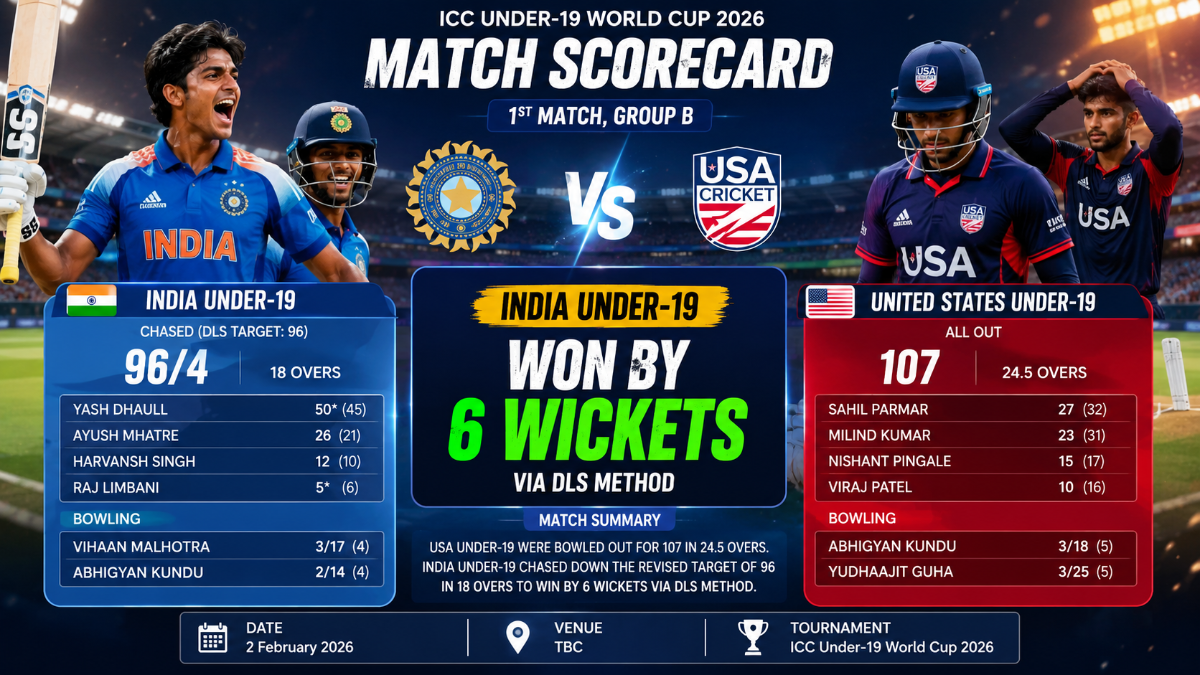
India Under-19 opened their ICC Under-19 World Cup 2026 campaign with a hard-fought six-wicket win over United States Under-19, and this India National Under-19 Cricket Team vs United States National Under-19 Cricket Team Match Scorecard breaks down every phase of the contest-from Henil Patel’s five-wicket burst to the rain-affected chase that tested India’s young batting order. What looked like a routine assignment against a lower-ranked opponent turned into a genuine examination of temperament once the weather intervened, and that’s the part most quick-glance scorecards fail to capture.
Quick Match Summary
India Under-19 defeated USA Under-19 by six wickets via the DLS method in their Group B opener at Queens Sports Club, Bulawayo, after restricting USA to 107 all out and chasing a revised target of 96 runs. This result gave India’s under-19 setup an ideal start to a tournament they’ve historically dominated, while exposing early cracks in USA’s batting depth that would resurface later in the group stage. India National Under-19 Cricket Team vs United States National Under-19 Cricket Team Match Scorecard, the headline numbers tell only part of the story. The real turning points came from a disciplined bowling spell and a batting recovery under pressure-elements that a bare score line simply cannot communicate. This match, on paper, reads like a comfortable victory. In practice, it was a tactical chess match decided by a handful of overs on either side of the innings break.
Match Facts at a Glance
Before diving into the ball-by-ball breakdown, here’s the snapshot most readers search for first when they type in queries around this fixture.
| Detail | Information |
| Match | 1st Match, Group B, ICC Men’s Under-19 World Cup 2026 |
| Venue | Queens Sports Club, Bulawayo, Zimbabwe |
| Date | January 15, 2026 |
| Result | India Under-19 won by 6 wickets (DLS method) |
| Teams | India National Under-19 Cricket Team vs United States National Under-19 Cricket Team |
| Original target | 108 runs |
| Revised DLS target | 96 runs off 37 overs |
| India’s chase completed in | 17.2 overs |
| Standout bowler | Henil Patel (5-wicket haul) |
| Standout batter | Abhigyan Kundu (unbeaten, match-sealing knock) |
| Tournament stage | Group B, opening fixture |
This India Under-19 cricket team vs USA Under-19 scorecard confirms a clean, if weather-interrupted, victory margin-but the composition of that win matters more than the final score alone.
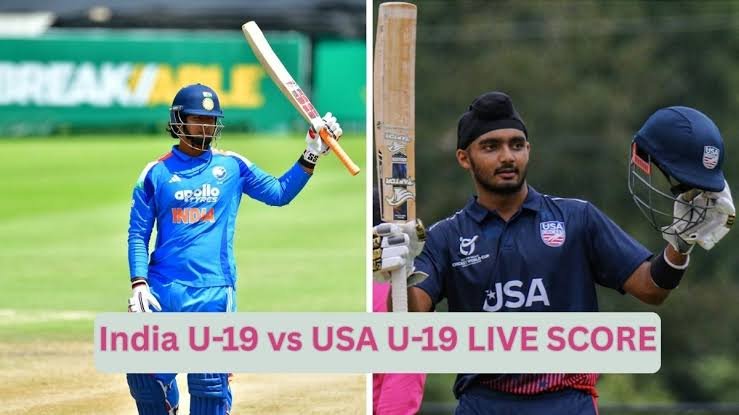
Why This Match Mattered for India’s Campaign
India entered this fixture as five-time champions and clear tournament favorites, carrying the weight of expectation into every group match. A comfortable-on-paper opener against USA still demanded sharp execution, since any slip in the group stage can complicate net run rate calculations heading into the knockout rounds. Winning convincingly-even through a rain-hit chase-set the right tone early and gave the squad a confidence boost heading into tougher fixtures against Bangladesh and New Zealand later in the group. There’s also a psychological dimension worth noting. Opening a World Cup campaign with any kind of stumble, even a recoverable one, can create doubt within a young squad that hasn’t yet built the resilience senior teams develop over years of competition. India’s ability to steady itself after slipping to 25/3 became, in a sense, a low-stakes rehearsal for handling pressure in matches where the margin for error would be far smaller.
USA Under-19 Batting Collapse: How It Happened
USA Under-19 was bowled out for 107 in 35.2 overs, and the innings unraveled almost from the start. Understanding why this collapse happened is more useful than simply reading the fall-of-wickets column, because it explains the tactical decisions that shaped the rest of the match.
Read More: United Arab Emirates National Cricket Team vs Oman National Cricket Team Match Scorecard
Early Wickets Set the Tone
USA lost their first wicket in the second over, with Amrinder Gill dismissed for just 1 run in the 1.3rd over. That early setback forced USA’s middle order to rebuild from behind almost immediately, a position that’s difficult to recover from against a disciplined new-ball attack operating in helpful bowling conditions. Losing an opener inside the first two overs typically forces a batting side into one of two approaches: either the remaining top-order batters play with heightened caution to rebuild the innings, or they attempt to counter-attack to regain momentum. USA’s response leaned toward caution initially, but that approach only delayed the inevitable pressure rather than relieving it.
The Middle-Order Freefall
By the 12th over, USA had slipped to 35/4, having lost Sahil Garg, Utkarsh Srivastava, and Arjun Mahesh in quick succession. This cluster of wickets between overs 8 and 12 is the single biggest reason USA never threatened a competitive total-teams batting first at this level typically need at least one substantial partnership to post a defendable score, and USA never got one.
The fall-of-wickets sequence tells its own story clearly.
| Wicket | Team Score | Batter Dismissed | Over |
| 1st | 1 | Amrinder Gill | 1.3 |
| 2nd | 29 | Sahil Garg | 8.6 |
| 3rd | 34 | Utkarsh Srivastava | 11.2 |
| 4th | 35 | Arjun Mahesh | 11.6 |
| 5th | 39 | Amogh (partial name in source records) | – |
This pattern shows a batting order that never found rhythm. A gap of 28 runs between the first and second wickets suggested a brief stabilization, but the collapse from 29/1 to 39/5 inside a handful of overs completely undid that early platform.
Henil Patel’s Five-Wicket Haul: The Defining Spell
Henil Patel finished with five wickets, and his spell was the tactical difference-maker in this fixture. Rather than bowling short and expecting bounce, Patel worked with consistent hard lengths and movement off the seam, a plan clearly set by the India think-tank to exploit early-innings conditions at Queens Sports Club. What makes this spell significant beyond the raw numbers is timing. Patel struck at intervals that prevented USA from ever building momentum, rather than picking up “cheap” wickets once the total was already beyond saving. That’s the kind of context a raw scorecard never shows, but it’s exactly what separates a good bowling performance from a match-winning one. In under-19 cricket specifically, where technique is still developing and batters are more susceptible to consistent line-and-length bowling than flashy variations, a spell like this can dictate an entire innings.
The Tail Offers No Resistance
Once the middle order fell away, USA’s lower order failed to mount any meaningful recovery, and the innings folded for 107 in 35.2 overs. A total under 110 in a 50-over format is rarely competitive at this level unless supported by exceptional bowling and fielding-which is exactly what India would need to demonstrate in the field, and largely did, aside from the weather-induced complications that followed.
India Under-19 Chase: Comfortable Target, Uncomfortable Path
Chasing 107 should have been routine. Instead, India’s innings became a study in composure under artificial pressure once rain intervened and reshaped the calculus of the chase entirely.
The DLS Revision Changed the Equation
Rain interrupted India’s chase partway through, triggering a Duckworth-Lewis-Stern (DLS) recalculation that reduced the target from 108 to 96 runs off 37 overs. While a lower target sounds like an advantage on the surface, DLS revisions often compress risk-reward calculations for batting sides, forcing them to either accelerate unnaturally or play with more caution than a straightforward chase would require. This is a nuance that casual viewers frequently misunderstand. A “smaller” target doesn’t automatically mean an “easier” chase-it means a different chase, with different required run rates at different stages, and a psychological shift where batters sometimes misjudge how much time and overs they genuinely have in hand.
Early Wobble: India Slips to 25/3
This is the phase most match reports underplay. Vaibhav Suryavanshi, one of the most closely watched young batters in the squad, was dismissed for just 2 runs, and India found themselves at 25/3-a genuinely uncomfortable position against a total that looked “easy” on paper. At this point, USA had real belief that a defendable score plus tight bowling could produce an upset. Three wickets down inside the first several overs against a target under 100 is not a position any batting side wants to be in, regardless of how modest the overall chase appears. It forces the next set of batters into a decision: rebuild patiently and risk running out of overs against the DLS-adjusted rate, or take risks immediately and potentially compound the damage.
Abhigyan Kundu’s Match-Sealing Innings
Abhigyan Kundu played the innings that ultimately decided the match, batting through the early collapse and finishing unbeaten to guide India home. His approach-absorbing pressure first, then accelerating once the platform was secure-reflects exactly the kind of match-awareness selectors and coaches prioritize at the under-19 level. Kundu’s closing six over long-on wasn’t just a boundary, it was a statement that India’s young core could handle pressure imposed by conditions rather than just the opposition. In many ways, this kind of finish under a revised target is a more valuable data point for selectors than a chase completed comfortably in normal conditions, because it demonstrates game awareness under a shifting set of parameters-reading overs remaining, required rate, and wickets in hand simultaneously.
Why the Chase Deserves More Credit Than the Scoreline Suggests
A six-wicket win with balls in hand often reads as routine when scanned quickly. This chase was anything but routine once you factor in the top-order stumble and the psychological shift a DLS target creates. Teams that recover from 25/3 against a modest total-rather than cruising to victory-demonstrate a more valuable form of composure heading into tougher group and knockout fixtures where such recoveries will matter far more.
Head-to-Head: India National Under-19 Cricket Team vs United States National Under-19 Cricket Team Match Scorecard Level
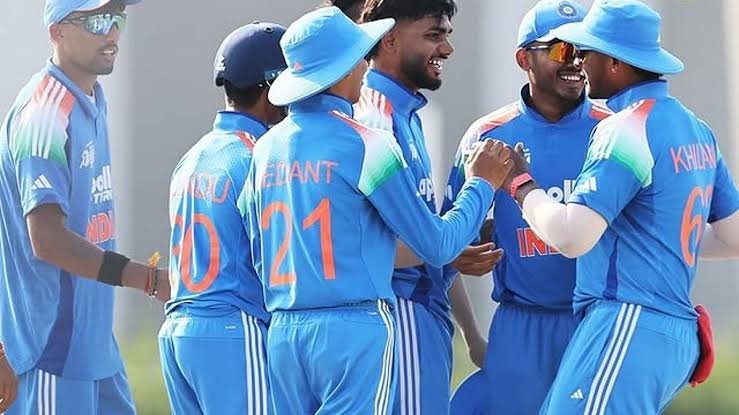
Looking beyond this single fixture, India’s Under-19 side has historically held a dominant record against USA Under-19 in ICC tournament settings, reflecting the broader gap in structural depth between the two cricket programs at the youth level.
| Metric | India Under-19 | USA Under-19 |
| Match result | Won | Lost |
| Total runs scored | 99/4 (chasing) | 107 all out |
| Overs faced | 17.2 (DLS-adjusted) | 35.2 |
| Wickets lost | 4 | 10 |
| Standout individual | Abhigyan Kundu (unbeaten) | None sustained beyond early order |
| Bowling standout | Henil Patel (5 wickets) | No comparable standout spell |
This table underlines a simple truth, India’s win margin understates how tightly the early stages of the chase were contested, while USA’s collapse shows how quickly a promising start (29/1) can unravel into a below-par total (107 all out).
Read Also: Sikkim Cricket Team vs Mumbai Cricket Team Match Scorecard
Statistical Context: What the Numbers Reveal
Beyond the headline scorecard, a few patterns stand out when you look at this match in the context of the broader tournament.
USA’s Recurring Top-Order Fragility
USA’s batting struggles weren’t isolated to this match. In a later group-stage fixture, USA slipped to 40/5 before a century of rescue innings pulled them back into contention. This pattern-fast, early wickets followed by a rebuild-suggests a structural vulnerability in USA’s top six that opposition bowling attacks specifically targeted through the group stage. It’s a tendency that tournament-watchers should track across USA’s remaining fixtures, since repeated early-order failures rarely self-correct without a change in batting approach or personnel.
India’s Bowling Depth on Display
Henil Patel‘s five-for wasn’t a solo effort happening in isolation-it reflected a broader trend of India’s bowling attack applying pressure through discipline rather than raw pace. For a team with historical dominance in this tournament (five previous titles), consistent bowling depth across matches matters more than any single standout spell, and this match offered early evidence that the depth was there heading into the group stage.
Comparing the Two Innings Side by Side
| Phase | USA Under-19 Innings | India Under-19 Innings |
| Start | Lost wicket in over 2 | Steady start before DLS revision |
| Middle | Collapsed from 29/1 to 39/5 | Slipped to 25/3 early |
| Recovery | No sustained recovery | Kundu’s unbeaten innings stabilized chase |
| Finish | All out for 107 | Won at 99/4 |
This side-by-side view highlights an interesting symmetry, both sides suffered early-innings wobbles, but only India’s recovery held. That difference-not the final score line is the real separator in this match.
Tournament and Group Stage Implications
This win placed India in a strong early position within Group B, a pool that also included Bangladesh and New Zealand in later fixtures. Group-stage net run rate calculations can matter significantly when multiple teams finish with similar win-loss records, so a clean, complete victory-even a rain-affected one-carries extra weight beyond just the two points earned. For the USA, the defeat was an early signal that their batting order needed reinforcement before facing stronger attacks later in the group. Under-19 tournaments compress margins for error significantly compared to senior cricket, since young batting units rarely have the experience to recover from repeated top-order failures across a full campaign. A single bad session against a well-drilled bowling attack can define an entire group-stage outcome.
What This Result Meant Heading Into Later Fixtures
India carried this momentum into subsequent group matches, using the confidence from a hard-fought win (rather than an easy one) to build belief within the squad. For USA, the challenge became clear early: address the top-order fragility before it cost them a genuinely winnable match against a mid-tier opponent later in the tournament.
Key Takeaways From This India National Under-19 Cricket Team vs United States National Under-19 Cricket Team Match Scorecard
- Result: India Under-19 won by 6 wickets via the DLS method
- USA total: 107 all out in 35.2 overs
- India’s chase: 99/4 in 17.2 overs against a revised target of 96
- Standout bowler: Henil Patel (5 wickets)
- Standout batter: Abhigyan Kundu (unbeaten, match-winning knock)
- Turning point: India’s recovery from 25/3 after Vaibhav Suryavanshi’s early dismissal
- Bigger pattern: USA’s top-order fragility resurfaced in later group matches
- Tournament impact: Set the tone for India’s Group B campaign against Bangladesh and New Zealand
Frequently Asked Questions:
Who won the India U19 vs USA U19 match in the 2026 Under-19 World Cup?
India Under-19 won by six wickets via the DLS method after bowling USA Under-19 out for 107.
What was the full scorecard result for this match?
USA Under-19 scored 107 all out in 35.2 overs, and India Under-19 chased down the revised target with 99/4 in 17.2 overs.
Why was the target changed to 96 runs?
Rain interrupted India’s chase, and the Duckworth-Lewis-Stern method revised the original target of 108 down to 96 runs off 37 overs.
Who was the standout bowler for India in this match?
Henil Patel was the standout performer, taking a five-wicket haul to dismantle USA’s batting order.
Who played the key batting innings for India?
Abhigyan Kundu played the decisive unbeaten innings, steering India through a top-order collapse to seal the win.
Why did India lose early wickets while chasing a small target?
The DLS-revised target created artificial urgency, and India lost three wickets early-including Vaibhav Suryavanshi for just 2 runs-before recovering.
Where was this India U19 vs USA U19 match played?
The match was played at Queens Sports Club in Bulawayo, Zimbabwe.
What group was India placed in during the 2026 Under-19 World Cup?
India competed in Group B, which also featured Bangladesh and New Zealand in later matches.
How many times has India won the Under-19 World Cup before this tournament?
India Under-19 entered the 2026 tournament as five-time champions, the most successful team in the competition’s history.
Did USA Under-19 show similar batting struggles in other matches?
Yes, USA slipped to 40/5 in a later group-stage match before a century innings helped them recover, suggesting a recurring top-order vulnerability throughout their campaign.