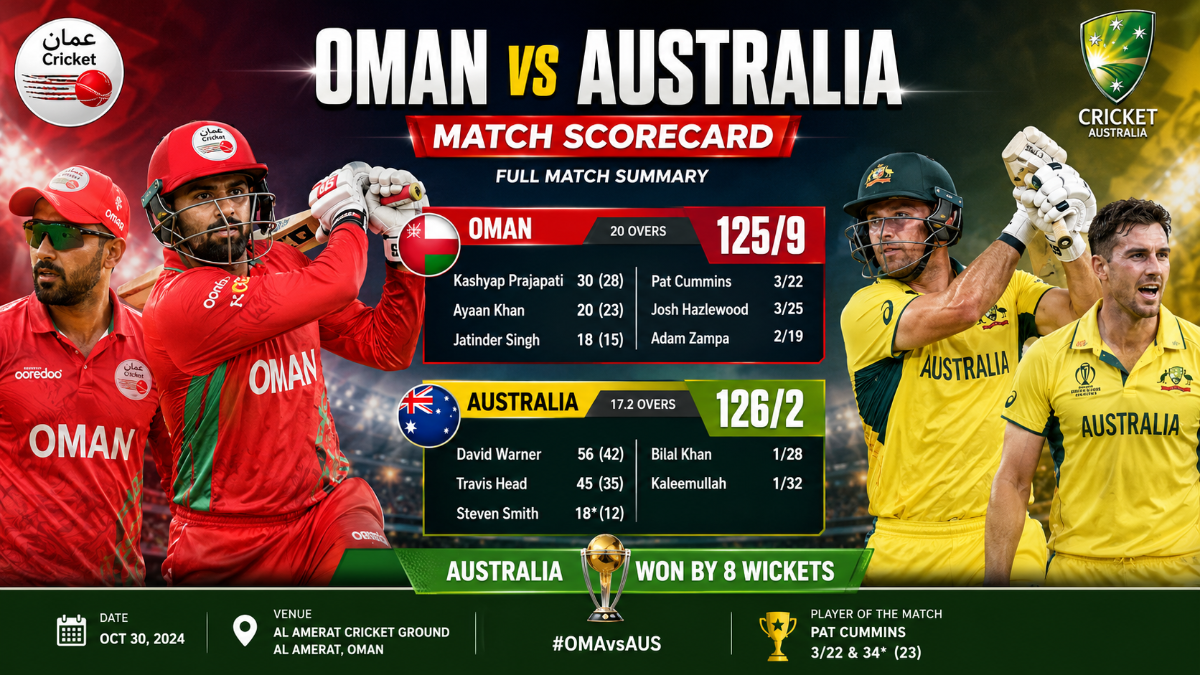
Australia defeated Oman by nine wickets in their final Group B fixture of the ICC Men’s T20 World Cup 2026, bowling Oman out for 104 runs before completing the chase in just 9.4 overs at Pallekele International Cricket Stadium. This Oman National Cricket Team vs Australia National Cricket Team match scorecard tells the story of a lopsided contest, where Adam Zampa’s spin mastery and a blistering opening stand between Mitchell Marsh and Travis Head turned a dead-rubber fixture into one of the most emphatic results of the tournament’s group stage.
Oman National Cricket Team vs Australia National Cricket Team match scorecard, ball-by-ball breakdown, fall of wickets, power play scores, and Player of the Match details, this guide covers every statistical angle along with the tactical reasoning behind Australia’s dominant nine-wicket victory. Whether you’re a stats-driven reader, a fantasy cricket enthusiast building your next XI, or simply a fan who missed the live coverage, this breakdown gives you everything in one place.
Match Facts And Quick Summary
Australia won by 9 wickets after restricting Oman to 104 all out in 16.2 overs and chasing the target down for the loss of just Travis Head, finishing at 108/1 in 9.4 overs. This snapshot table gives readers the fastest possible answer to the core question behind every Oman National Cricket Team vs Australia National Cricket Team match scorecard search-who won, by how much, and who stood out on the day.
| Match Fact | Detail |
| Winner | Australia |
| Margin | 9 wickets |
| Player of the Match | Adam Zampa |
| Highest Individual Score | Mitchell Marsh-64* (33 balls) |
| Best Bowling Figures | Adam Zampa-4/21 |
| Venue | Pallekele International Cricket Stadium |
| Toss | Australia won, chose to field first |
| Tournament Stage | Group B, ICC Men’s T20 World Cup 2026 |
| Match Format | Twenty20 International (T20I) |
| Winning Margin (Balls Remaining) | 61 balls unused |

Why This Match Mattered Despite Being A Dead Rubber
Neither side had a realistic path to the Super Eight stage heading into this fixture, yet the intensity on the field never dropped. Australia treated the match as an opportunity to fine-tune combinations ahead of future assignments, while Oman’s leadership had spoken confidently before the toss about testing Australia’s bowling attack and finishing the tournament on a competitive note. The final scoreline, however, reflected a wide gulf in class rather than a genuine contest between equals. Dead rubbers often carry a reputation for lacking intensity, but this fixture disproved that notion almost instantly. Australia’s bowlers attacked with the same discipline they had shown in their earlier, more consequential matches, while their batters chased down the target with a ruthlessness usually reserved for knockout contests. That competitive spirit, even in a game without stakes, is often what separates elite teams from developing ones-a theme that ran throughout this entire fixture.
Oman Innings: Full Batting Scorecard
Oman’s innings unraveled early and never recovered, with wickets falling in clusters through the power play and middle overs on a pitch offering pace, carry, and bounce that suited Australia’s tall seam-bowling attack far more than Oman’s batting lineup.
Read More: Sri Lanka National Cricket Team vs Oman National Cricket Team Match Scorecard
Batting Breakdown
| Batter | Dismissal | Runs | Balls | Strike Rate |
| Aamir Kaleem | b Bartlett | 0 | 1 | 0.00 |
| Jatinder Singh (c) | b Bartlett | 17 | 15 | 113.33 |
| Karan Sonavale | b Ellis | 12 | 11 | 109.09 |
| Hammad Mirza | b Zampa | 16 | 13 | 123.08 |
| Wasim Ali | b Maxwell | 32 | 33 | 96.97 |
| Mohammad Nadeem | lbw Zampa | 2 | 3 | 66.67 |
| Vinayak Shukla (wk) | c Green b Stoinis | 9 | 8 | 112.50 |
| Jiten Ramanandi | lbw Maxwell | 1 | 3 | 33.33 |
| Shakeel Ahmed | c Bartlett b Zampa | 3 | 7 | 42.86 |
| Jay Odedra | not out | 4 | 3 | 133.33 |
| Shafiq Jan | b Zampa | 0 | 1 | 0.00 |
Extras: 8 (6 wide, 2 leg-bye) | Total: 104 all out in 16.2 overs
Wasim Ali’s 32 off 33 balls was the only substantial contribution in an innings where no other batter crossed 20 runs, underlining just how comprehensively Australia’s attack controlled proceedings in this Oman National Cricket Team vs Australia National Cricket Team match scorecard. His innings included several well-timed drives through the covers, but the lack of support from the other end meant Oman could never build the kind of partnership needed to post a competitive total.
Fall Of Wickets-Oman Innings
- 0-1 (Aamir Kaleem, 0.1 overs)-first-ball dismissal, the earliest possible setback
- 26-2 (Jatinder Singh)-captain’s dismissal further dented morale
- 41-3 (Karan Sonavale)-third wicket inside the powerplay
- Powerplay score: 47-3 at the end of 6 overs
- 100-8 (Wasim Ali)-the innings effectively finished with his exit
- 104-10 (Shafiq Jan)-Oman bowled out in 16.2 overs
The pattern of wickets falling in the power play and again in a rapid cluster around the 100-run mark shows how Australia’s bowlers applied pressure in two distinct waves-first through pace with the new ball, and later through spin as the pitch began to grip more.
Australia Bowling Figures
| Bowler | Overs | Runs | Wickets | Economy |
| Adam Zampa | 3.2 | 21 | 4 | 6.30 |
| Glenn Maxwell | 4 | 13 | 2 | 3.25 |
| Xavier Bartlett | 4 | 27 | 2 | 6.75 |
| Nathan Ellis | 3 | 14 | 1 | 4.67 |
| Marcus Stoinis | 2 | 16 | 1 | 8.00 |
Glenn Maxwell‘s economy rate of 3.25 stood out as the most disciplined spell of the innings, even though Zampa grabbed the headlines with his four-wicket haul. Maxwell’s off-spin variations, mixed with subtle changes of pace, restricted Oman’s batters from finding boundaries during his overs, effectively squeezing the innings from both ends.
Why Oman’s Batting Approach Struggled
Oman’s batting lineup is built around aggressive intent rather than classical technique, a strategy that works well against associate-level bowling attacks but exposes technical gaps against a full-member seam and spin combination. Several dismissals in this innings came from batters attempting big shots against deliveries that demanded caution-a pattern typical when a developing team faces a significantly stronger bowling unit. The absence of a settled middle-order partnership compounded the problem, as no pair of batters managed more than 15 runs together at the crease.
Australia Innings: Full Batting Scorecard
Australia’s chase turned into a formality within the first ten overs, driven by an aggressive approach from both openers that left Oman’s bowlers with no answers and no room to build pressure.
Batting Breakdown
| Batter | Dismissal | Runs | Balls | Strike Rate |
| Mitchell Marsh (c) | not out | 64 | 33 | 193.94 |
| Travis Head | c & b Shakeel Ahmed | 32 | 19 | 168.42 |
| Josh Inglis | not out | 12 | 6 | 200.00 |
Total: 108/1 in 9.4 overs
Fall Of Wickets-Australia Innings
93-1 (Travis Head)-the only wicket to fall, arriving deep into the powerplay after a rapid opening stand. The fact that Australia lost only one wicket across the entire chase, and that too after the target was virtually secured, tells its own story about the gap in quality between the two attacks on this particular day.
Power play Explosion
Australia raced to 73/0 inside the first six overs, hitting 11 fours and 3 sixes, effectively deciding the match before the halfway mark of the chase. This kind of power play score against a modest target reflects intent rather than necessity-Australia’s batters chose to attack from ball one rather than settle into the chase cautiously, a tactical decision that both entertained the crowd and set an aggressive tone for the innings.
Read Also: Afghanistan National Cricket Team vs Canada National Cricket Team Match Scorecard
Oman Bowling Figures
| Bowler | Overs | Runs | Wickets | Economy |
| Shakeel Ahmed | 4 | 29 | 1 | 7.25 |
| Shafiq Jan | 3 | 30 | 0 | 10.00 |
| Jay Odedra | 1.4 | 21 | 0 | 12.60 |
| Wasim Ali | 1 | 18 | 0 | 18.00 |
| Jiten Ramanandi | 1 | 10 | 0 | 10.00 |
Every bowler in Oman’s attack conceded runs at more than seven per over, a rare occurrence even against a strong batting lineup, and it highlights how comprehensively Marsh and Head dictated terms throughout their stay at the crease.
Player Of The Match: Adam Zampa’s Match-Defining Spell
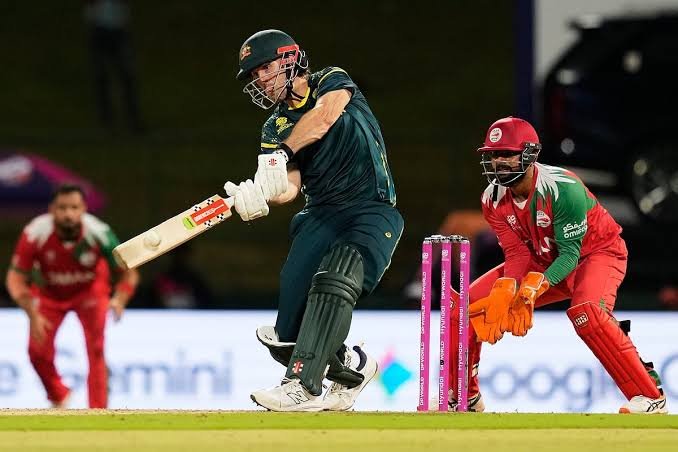
Adam Zampa was named Player of the Match for his figures of 4 wickets for 21 runs in 3.2 overs, a spell that dismantled Oman’s middle and lower order. Zampa had gone wicketless in Australia’s previous two group games, making this return to form particularly significant heading into future assignments beyond this tournament. His variations in pace and turn troubled Oman’s batters throughout his spell, with three of his four wickets coming via clean bowled dismissals-a testament to how much the ball was gripping and turning off the surface at Pallekele.
Why Zampa’s Spell Was Statistically Significant
This was Zampa’s first four-wicket haul of the 2026 edition and Australia’s first four-for by a spinner in the tournament, adding weight to why the Oman National Cricket Team vs Australia National Cricket Team match scorecard leaned so heavily in Australia’s favor. Bowling figures of 4/21 in a T20I are considered elite by any measure, and the fact that Zampa achieved this against a team he had limited prior data on speaks to his adaptability and reading of conditions on the day.
The Psychology Behind A Bounce-Back Performance
Wicketless spells in previous matches can weigh heavily on a bowler’s confidence, particularly a frontline spinner expected to be a matchwinner in most conditions. Zampa’s response-attacking rather than retreating into containment mode-reflects the mindset elite bowlers adopt when returning to form. Rather than bowling defensively to protect his figures, he continued to attack the stumps and invite mistakes, which ultimately paid off with four dismissals inside just twenty balls of bowling.
Key Records And Statistical Highlights
Numbers alone don’t tell the full story, but these standout figures explain why this contest was so decisively one-sided from start to finish.
- Australia completed the chase in just 58 balls (9.4 overs)-one of the fastest run chases of the group stage.
- Mitchell Marsh’s unbeaten 64 came at a strike rate of 193.94, his best individual score of the tournament so far.
- Zampa’s 4/21 stands as Australia’s most economical four-wicket haul in this World Cup edition.
- Oman’s top score of 32 from Wasim Ali was the only innings above 20 runs in their entire batting lineup.
- Australia’s 73-run powerplay was among the highest scored by any team in the first six overs during the group stage.
- Oman’s bowling unit conceded runs at an average economy rate above 9 across the entire Australian innings.
- Travis Head’s strike rate of 168.42 in a losing cause for Oman still ranks among the more explosive innings recorded against the associate nation this year.
These figures collectively illustrate a match dominated at almost every phase by the stronger side, with very few periods where Oman managed to apply sustained pressure.
Head-To-Head History: Australia Vs Oman
This was the second meeting between the two sides at a T20 World Cup. Australia also won the previous encounter comfortably, meaning Oman remained winless against Australia across multiple ICC T20 World Cup appearances. This growing head-to-head gap highlights the difference in experience and depth between a full-member nation and an associate side still building its T20I pedigree.
The Broader Gap Between Full Members And Associate Nations
Matches like this one continue to raise questions about competitive balance at global tournaments. While associate nations like Oman have earned their place through qualification, the gulf in resources, player pool depth, and match exposure against elite opposition remains significant. Oman’s bowlers, for instance, rarely get the opportunity to bowl against batters of Marsh and Head’s caliber outside major ICC events, and that inexperience showed clearly in their inability to adjust lengths and lines once the powerplay assault began.
Tournament Standing After This Result
The win closed Australia’s group-stage campaign with two victories from four matches, though it arrived too late to change their fate-they had already been eliminated from Super Eight contention before this fixture was even played. Oman, meanwhile, ended their campaign without a single win, a result that will sting despite the improved competitiveness shown in patches against stronger opposition throughout the tournament.
For Oman, tournaments like this remain valuable long-term even without wins, offering exposure that can accelerate development for a squad still finding its footing on the global stage. For Australia, results like this one-even in a dead rubber-offer selectors useful data on form and fitness heading into their next assignment.
Tactical Analysis: What Went Right For Australia
Snippet answer: Australia’s bowling unit exploited early pace and bounce with the new ball, while their top order attacked spin aggressively in the powerplay, combining to produce a comprehensive nine-wicket win.
Bowling Strategy And Field Placements
Xavier Bartlett’s decision to bowl fuller lengths early with an attacking slip cordon paid immediate dividends, removing Aamir Kaleem with the very first ball of the innings. Captain Mitchell Marsh then rotated his bowlers aggressively, bringing Zampa into the attack early to exploit the turn rather than waiting for the middle overs-a proactive captaincy call that paid off handsomely and set the tone for the rest of the innings.
This kind of early-innings aggression from the captain reflects modern T20 thinking, where the traditional approach of holding spinners back until overs seven through fifteen is increasingly being replaced by front-loading wicket-taking options whenever conditions favor them.
Batting Intent In The Chase
Rather than approaching the small target conservatively, Marsh and Head opened with calculated aggression, targeting Oman’s spin bowlers in particular. This intent-driven approach reflects a broader trend among top-order batters in modern T20 cricket, where risk is front-loaded to remove pressure from the middle overs and eliminate the need for late-innings acceleration against fresher bowlers.
Fielding And Pressure Building
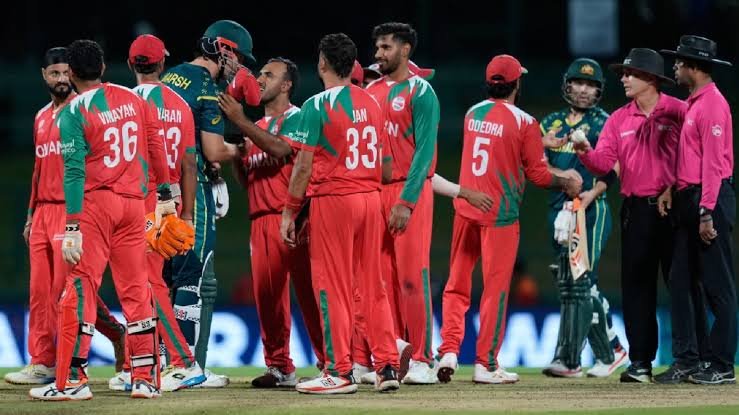
Beyond the headline batting and bowling numbers, Australia’s fielding unit also played a quiet but important role in restricting Oman’s scoring options. Sharp ground fielding cut off several potential boundaries in the middle overs, forcing Oman’s batters into taking greater risks to find the boundary rope-risks that ultimately led to several of the dismissals recorded in the scorecard.
Fantasy Cricket And Statistical Takeaways
For readers approaching this Oman National Cricket Team vs Australia National Cricket Team match scorecard from a fantasy cricket perspective, a few names stand out clearly. Adam Zampa’s bowling figures alone would have delivered a significant fantasy points haul, while Mitchell Marsh’s unbeaten 64 combined with his captaincy bonus points made him arguably the most valuable pick across both lineups. Travis Head’s quickfire 32, despite ending in a dismissal, still contributed strong strike-rate-based points given the format’s emphasis on boundary hitting and run-scoring pace.
On the Oman side, Wasim Ali’s 32 stands as the only individual performance worth flagging from a statistical standpoint, given the otherwise underwhelming batting returns across the rest of the lineup.
Frequently Asked Questions:
Who won the Oman National Cricket Team vs Australia National Cricket Team match?
Australia won by 9 wickets, chasing 105 in 9.4 overs after bowling Oman out for 104.
Who was the Player of the Match in the Australia vs Oman T20 World Cup 2026 fixture?
Adam Zampa, for his bowling figures of 4 wickets for 21 runs in 3.2 overs.
What was Oman’s total in this match?
Oman were bowled out for 104 runs in 16.2 overs.
How did Australia complete the chase so quickly?
Mitchell Marsh (64* off 33) and Travis Head (32 off 19) added 93 runs for the first wicket in just 49 balls, allowing Australia to finish the chase in 9.4 overs.
Did this result affect Super Eight qualification for either team?
No, both teams had already been eliminated from Super Eight contention before this match was played.
Where was the Australia vs Oman match played?
The match was played at Pallekele International Cricket Stadium.
Who won the toss in the Oman vs Australia match?
Australia won the toss and chose to bowl first.
What was the highest individual score in the match?
Mitchell Marsh’s unbeaten 64 off 33 balls was the highest individual score of the match.
How many wickets did Adam Zampa take, and what were his figures?
Adam Zampa took 4 wickets for 21 runs in 3.2 overs, his best bowling performance of the tournament.
Has Australia ever lost to Oman in a T20 World Cup?
No, Australia have won both their T20 World Cup meetings against Oman, with Oman remaining winless in the head-to-head record.