Sri Lanka thrashed Oman by 105 runs in one of the most lopsided contests of the ICC Men’s T20 World Cup 2026 group stage, posting 225/5 before bowling out the co-hosts for a modest 120/9 at the Pallekele International Cricket Stadium. Pavan Rathnayake’s blistering 60 off 28 balls earned him the Player of the Match award, capping a night where Sri Lanka’s batting depth and bowling discipline exposed the gulf in experience between the two sides. Sri Lanka National Cricket Team vs Oman National Cricket Team Match Scorecard covers every batting card, bowling figure, fall of wicket, partnership, and tactical decision that shaped the result on February 12, 2026-Match 16 of Group B. Whether you’re here for the raw numbers or the story behind them, this breakdown gives you both.
Match Summary: Result at a Glance
Sri Lanka won the Sri Lanka National Cricket Team vs Oman National Cricket Team fixture by a commanding 105 runs, continuing their unbeaten run in this tournament’s group phase. Oman won the toss and elected to field first, a fairly standard decision on a Pallekele surface known for assisting stroke-play once the ball loses its hardness-but the plan backfired the moment Sri Lanka’s middle order found their range.
Key Match Details
| Detail | Information |
| Result | Sri Lanka won by 105 runs |
| Toss | Oman, elected to field first |
| Venue | Pallekele International Cricket Stadium, Kandy |
| Match Date | February 12, 2026 |
| Player of the Match | Pavan Rathnayake |
| Tournament | ICC Men’s T20 World Cup 2025–26, Group B, Match 16 |
| Sri Lanka Total | 225/5 (20 overs) |
| Oman Total | 120/9 (20 overs) |
| Margin | 105 runs |

This result extended Sri Lanka’s dominant historical record over Oman in white-ball cricket, and it was arguably the most one-sided margin of victory in the group stage up to that point in the tournament.
Why This Match Mattered in the Group B Context
Group stage matches against lower-ranked associate nations often get dismissed as formalities, but this fixture carried real weight for both sides. For Sri Lanka, a co-host nation under pressure to justify home advantage, a comprehensive win was about building momentum and net run rate cushion heading into a group that also included Australia and Zimbabwe. For Oman, appearing in their second consecutive T20 World Cup as a genuine associate success story, this was a chance to prove they belonged on the same stage as full-member nations. The result didn’t just decide two points-it reshaped the net run rate table in Group B, a metric that often determines Super 8 qualification when results are tightly bunched. Sri Lanka’s dominant batting performance combined with disciplined bowling gave them an NRR boost that later proved psychologically significant, even if it wasn’t mathematically decisive at that stage of the group.
Pallekele as a Sri Lanka National Cricket Team vs Oman National Cricket Team Match Scorecard: Conditions and Historical Context
The Pallekele International Cricket Stadium in Kandy is renowned for being one of the more batter-friendly venues in Sri Lankan cricket, particularly under lights. The pitch typically offers true bounce early, rewarding batters who commit to their shots, before slowing marginally in the second innings as dew and wear set in. This is exactly the pattern that played out in the Sri Lanka vs Oman contest-Sri Lanka’s batters, especially through the middle overs, found the ball coming onto the bat nicely, while Oman’s chase struggled against both the required rate and slightly more sluggish conditions later in the evening. Sri Lanka National Cricket Team vs Oman National Cricket Team Match Scorecard, because pitch behavior directly explains why Sri Lanka’s aggressive batting approach worked so cleanly and why Oman’s more conservative build-up never had time to convert into an actual chase.
Sri Lanka Batting Innings Breakdown: How 225/5 Was Built
Sri Lanka’s innings unfolded in two distinct phases-a watchful, occasionally shaky start from the top order, followed by an explosive middle-order surge that turned a competitive total into a match-defining one. This is the section of the scorecard that best explains why the final margin ballooned to 105 runs.
Read More: Australian Men’s Cricket Team vs Netherlands National Cricket Team Match Scorecard
Full Batting Card-Sri Lanka Innings
| Batter | Dismissal | Runs | Balls | 4s | 6s | Strike Rate |
| Kamil Mishara | b Odedra | 15 | 16 | 1 | 0 | 93.75 |
| Pathum Nissanka | lbw b Ramanandi | 42 | 78 | 2 | 0 | 53.85 |
| Kusal Mendis | run out | 61 | 45 | 6 | 0 | 135.55 |
| Pavan Rathnayake | b Ramanandi | 60 | 28 | 6 | 2 | 214.28 |
| Dasun Shanaka | c Nadeem Khan b Ramanandi | 50 | 19 | 2 | 5 | 263.15 |
| Kamindu Mendis | not out | 19 | 10 | – | – | – |
| Dunith Wellalage | not out | 6 | 4 | – | – | – |
Extras: 8 (lb 4, nb 2, w 2) | Total: 225/5 in 20 overs (Run rate: 11.25)
Fall of Wickets-Sri Lanka Innings
1-15 (Mishara, 1.4 overs), 2-42 (Nissanka, 5.1 overs), 3-136 (Rathnayake, 13.3 overs), 4-199 (Shanaka, 18.1 overs), 5-200 (Kusal Mendis, 18.2 overs)
The Opening Phase: A Cautious Start With Warning Signs
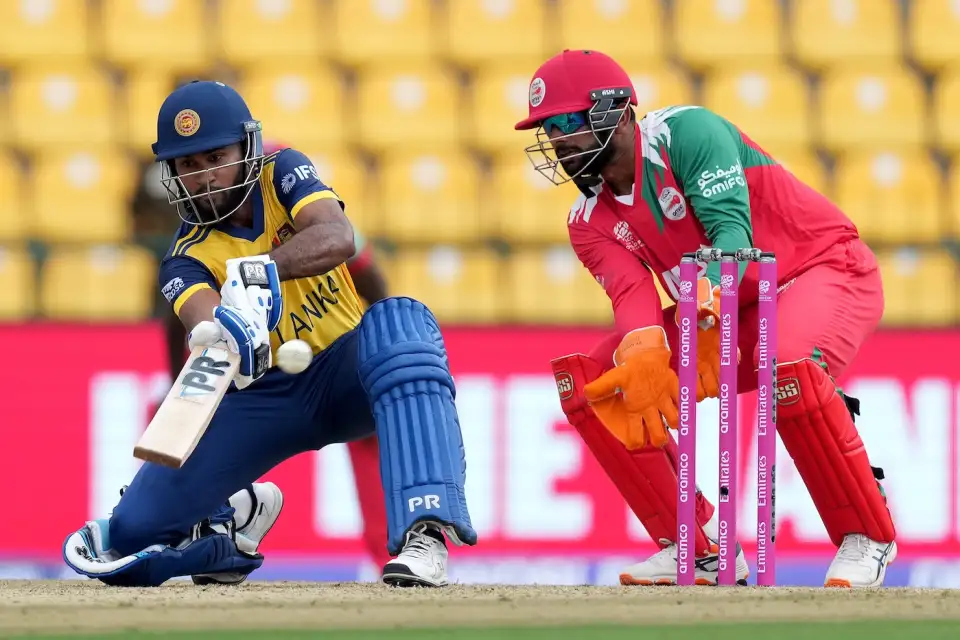
Kamil Mishara’s innings lasted just 16 balls before he was undone by Jay Odedra’s clever variation, an offspin delivery that held its line just enough to beat the outside edge and find the fielder at cover. It was a promising start from Oman’s bowling attack, and when Pathum Nissanka followed for 42 not long after-his dismissal only confirmed following a lengthy DRS review that overturned the on-field decision-Sri Lanka found themselves at a fairly modest 42/2. At this point, the innings genuinely could have stalled. Nissanka’s 78-ball knock, while useful for anchoring the innings, came at a strike rate of just 53.85, well below the tempo required to post a match-winning total. This is precisely why the middle-order response that followed became so significant.
The Mendis-Rathnayake Partnership: The Innings’ Turning Point
Kusal Mendis and Pavan Rathnayake completely transformed the complexion of the innings. Their third-wicket partnership added 94 runs off just 50 balls-a run rate in excess of 11 per over that took Sri Lanka from a cautious 42/2 into a position of total control by the halfway mark. Rathnayake’s approach was particularly notable. He reached his half-century off just 24 balls, striking six boundaries and two sixes along the way, before eventually falling to Jiten Ramanandi while attempting to manufacture width on a length ball outside off stump. His strike rate of 214.28 for the innings was the highest of any Sri Lankan batter and set the tone for the carnage that followed in the closing overs. Mendis, playing the more measured role within the partnership initially, later accelerated significantly himself, eventually falling for 61 off 45 balls to a run out as Sri Lanka pushed hard for the 200-run mark. His innings included six boundaries and, crucially, provided the platform from which Dasun Shanaka would launch the innings’ most destructive phase.
The Shanaka Finish: 50 Off Just 19 Balls
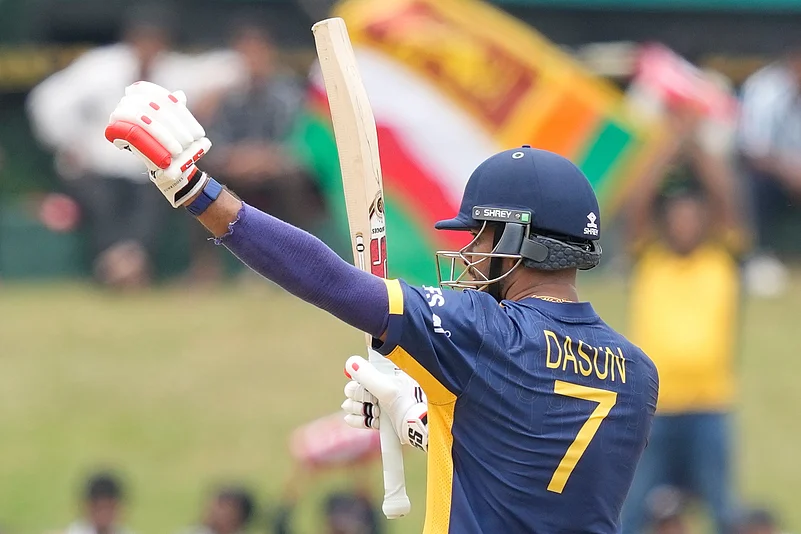
If the Mendis-Rathnayake stand set the platform, Dasun Shanaka’s cameo turned a good total into an intimidating one. Batting at a strike rate of 263.15, Shanaka’s 50 runs came off just 19 deliveries, featuring two fours and five sixes in an innings of pure calculated violence. Facing an Oman bowling attack that had already been stretched thin by the earlier partnership, Shanaka targeted the shorter boundary consistently, putting the finishing touches on what became a 225-run total. Sri Lanka National Cricket Team vs Oman National Cricket Team Match Scorecard that best illustrates the gap in death-overs execution between the two sides-Sri Lanka’s finishing was ruthless, while Oman’s bowlers had no answer in the closing stages.
Oman Bowling Figures: Where the Attack Held and Where It Broke
Jiten Ramanandi was Oman’s most successful bowler, taking 2 wickets for 41 runs in his four overs. Jay Odedra also claimed a wicket, but Sri Lanka’s batters dominated throughout the innings, helping their side post a commanding total of 225/5 in 20 overs.
Oman’s Full Bowling Card
| Bowler | Overs | Maidens | Runs | Wickets | Economy |
| Shah Faisal | 4 | 0 | 28 | 0 | 7.00 |
| Jay Odedra | 1 | 0 | 14 | 1 | 14.00 |
| Wasim Ali | 3 | 0 | 38 | 0 | 12.66 |
| Sufyan Mehmood | 4 | 0 | 60 | 1 | 15.00 |
| Nadeem Khan | 4 | 0 | 40 | 0 | 10.00 |
| Jiten Ramanandi | 4 | 0 | 41 | 2 | 10.25 |
Jiten Ramanandi was comfortably Oman’s most effective bowler, finishing with figures of 2/41, but even his numbers reflect an attack that simply lacked the depth and variation to contain a Sri Lankan batting order operating with clear intent throughout the innings. The other end of the bowling card tells a harder story. Sufyan Mehmood’s economy rate of 15.00 and Wasim Ali’s 12.66 highlight how quickly Oman’s death-overs options were dismantled once Shanaka got going. Shah Faisal’s figures of 0/28 in his four overs look reasonably tidy on paper, but they came largely in the powerplay before the acceleration phase began-a reminder that raw economy figures without context can be misleading in T20 analysis.
Oman’s Chase: A Powerplay Collapse That Decided Everything
Oman’s reply to the 226-run target effectively ended inside the first six overs. Chasing at a required rate approaching 11.3 per over from the outset, the co-hosts slipped to 36/3 in the powerplay-a deficit that no batting order at this level of collective experience was equipped to recover from.
Oman Full Batting Card
| Batter | Dismissal | Runs | Balls |
| Jatinder Singh | bowled | 1 | 2 |
| Aamir Kaleem | lbw | 6 | 5 |
| Hammad Mirza | caught | 9 | 12 |
| Mohammad Nadeem | not out | 53 | 56 |
| Wasim Ali | caught (wk) | 27 | 20 |
| Vinayak Shukla | run out | 1 | 1 |
| Jiten Ramanandi | stumped | 0 | 1 |
| Nadeem Khan | caught | 2 | 3 |
| Sufyan Mehmood | run out | 1 | 1 |
| Shah Faisal | caught | 1 | 8 |
| Jay Odedra | not out | 4 | 12 |
Extras: 15 (lb 1, w 13, nb 1) | Total: 120/9 in 20 overs (Run rate: 6.00)
Fall of Wickets-Oman Innings
1-12 (Jatinder Singh, 0.6), 2-12 (Aamir Kaleem, 1.1), 3-36 (Hammad Mirza, 5.5), 4-78 (Wasim Ali, 11.5), 5-79 (Vinayak Shukla, 11.6), 6-91 (Ramanandi, 12.4), 7-95 (Nadeem Khan, 13.2), 8-100 (Mehmood, 13.6), 9-109 (Faisal, 16.2)
Why the Powerplay Collapse Was Structural, Not Accidental
Dushmantha Chameera struck in his very first over of the chase, dismissing opening batter Jatinder Singh with a delivery that straightened sharply off the seam and clattered into the stumps. It was a statement start for Sri Lanka’s pace attack and set the tone for everything that followed.
Maheesh Theekshana followed almost immediately, removing Aamir Kaleem via an lbw decision confirmed on review through umpire’s call in his opening spell. The wicket came from a classic offspinner’s plan-bowling into the pads and trusting the drift to beat the inside edge-and it worked to perfection against a batter still finding his footing at the crease. A sharp piece of fielding then accounted for Hammad Mirza, with Kusal Mendis converting a difficult chance into a clean dismissal. By the time Oman reached 36/3 inside six overs, the required run rate had already climbed to a level that their batting depth simply could not match, regardless of intent. This is the tactical heart of the Sri Lanka National Cricket Team vs Oman National Cricket Team Match Scorecard: the match wasn’t lost in the final overs-it was lost in the powerplay, and everything after that point was Oman playing for pride rather than for a genuine chase.
Mohammad Nadeem’s Record-Breaking Fifty
Mohammad Nadeem’s unbeaten 53 was the standout individual performance of Oman’s innings, arriving too late in the context of the match result but significant in the broader history of the tournament. At 43 years and 161 days old, Nadeem became the oldest player to score a half-century in any ICC tournament, surpassing the previous record held by a Netherlands player in earlier editions. His innings, which took 56 balls to complete, is also recognized as the joint-slowest fifty in men’s T20 World Cup history, matching Mohammad Rizwan’s effort for Pakistan against Canada in the 2024 edition of the tournament. While the slow strike rate reflected the difficulty of batting against a total that was already out of reach, the milestone itself is a genuine piece of cricketing history and a highlight for association-nation cricket fans following this scorecard.
Sri Lanka Bowling Card: The Attack That Sealed the Win
| Bowler | Overs | Maidens | Runs | Wickets | Economy |
| Dushmantha Chameera | 2 | 0 | 19 | 2 | 9.50 |
| Maheesh Theekshana | 4 | 0 | 11 | 2 | 2.75 |
| Matheesha Pathirana | 3 | 0 | 11 | 0 | 3.66 |
| Dunith Wellalage | 4 | 0 | 17 | 1 | 4.25 |
| Dasun Shanaka | 1 | 0 | 6 | 0 | 6.00 |
| Dushan Hemantha | 4 | 0 | 45 | 1 | 11.25 |
| Kamindu Mendis | 2 | 0 | 10 | 1 | 5.00 |
Maheesh Theekshana was the standout bowler in this fixture, conceding just 11 runs across 4 overs for an economy rate of 2.75-a spell that effectively strangled any hope of an Oman comeback in the middle overs. It’s worth noting the contrast in Dushan Hemantha’s figures-1/45 from his four overs-against the rest of the attack. As a bowler filling in for the injured Wanindu Hasaranga, Hemantha absorbed more punishment than his teammates, largely from Mohammad Nadeem and Wasim Ali targeting him specifically during their brief rebuilding phase. This is a useful reminder that team-wide bowling dominance doesn’t always mean uniform individual performances.
Powerplay Comparison: The Single Statistic That Explains the Result
| Team | Powerplay Score | Wickets Lost |
| Sri Lanka | 58/2 (6 overs) | 2 |
| Oman | 36/3 (6 overs) | 3 |
The powerplay gap-Sri Lanka scoring 22 more runs while losing one fewer wicket-is arguably the single clearest number explaining the eventual 105-run margin of victory in this contest. Powerplay performance in T20 cricket is often the single strongest predictor of match outcome, and this fixture reinforces that pattern almost perfectly. Sri Lanka’s ability to build a platform without excessive risk in the first six overs, followed by acceleration through the middle, is a textbook template for T20 batting success. Oman’s collapse to 36/3 in the same phase, by contrast, removed any margin for error in their chase before it had even properly begun.
Tactical Breakdown: Captaincy Decisions and Bowling Plans
Dasun Shanaka‘s captaincy decisions throughout the match reflected a clear game plan. Bringing Maheesh Theekshana into the attack early in the power play, rather than saving him for the middle overs as is common practice, disrupted Oman’s batting rhythm before their top order could settle. This proactive use of a frontline spinner against a relatively inexperienced batting line-up paid immediate dividends. Shanaka’s own batting cameo late in Sri Lanka’s innings also reflected sound tactical awareness-recognizing the value of maximizing the final overs against a tiring bowling attack rather than preserving wickets unnecessarily.
For Oman, captain Jatinder Singh’s post-match reflections were notably candid. He acknowledged that his squad included very few players with substantial T20I experience at the highest level, a structural disadvantage that became evident the moment Sri Lanka’s bowlers found early success. This kind of honest self-assessment from an associate-nation captain is valuable context for understanding why the scoreline reached the margin it did-this wasn’t simply a bad day for Oman, but a reflection of the broader experience gap between full-member and associate cricket at this stage of the sport’s development.
Group B Standings After This Result
| Team | Matches | Won | Lost | Points | NRR |
| Sri Lanka | 2 | 2 | 0 | 4 | 3.125 |
| Australia | 1 | 1 | 0 | 2 | 3.350 |
| Zimbabwe | 1 | 1 | 0 | 2 | 2.702 |
| Ireland | 2 | 0 | 2 | 0 | -2.175 |
| Oman | 2 | 0 | 2 | 0 | -4.306 |
This result meant Sri Lanka moved to the top of Group B on the strength of net run rate, overtaking Australia despite having played an extra match. For Oman, the loss left them winless with a heavily negative net run rate, putting significant pressure on their remaining fixtures if they hoped to have any mathematical path toward Super 8 qualification.
What This Result Means Going Forward
For Sri Lanka, this comprehensive win did more than add two points to the table-it built genuine momentum and confidence heading into tougher fixtures later in the group stage. A batting order capable of recovering from 42/2 to post 225 demonstrates exactly the kind of depth and adaptability that tournament-winning sides typically need.
For Oman, despite the heavy defeat, Mohammad Nadeem’s record-breaking innings offered a genuine silver lining and a reminder of the value associate nations bring to the sport’s biggest stage. Cricket’s growth at the international level depends on these moments-a 43-year-old veteran fighting to a fifty against a full-strength Test-playing attack is precisely the kind of storyline that keeps associate cricket relevant to a global audience.
Frequently Asked Questions:
Who won the Sri Lanka vs Oman match scorecard?
Sri Lanka won the Sri Lanka National Cricket Team vs Oman National Cricket Team match by 105 runs.
Who was named Player of the Match?
Pavan Rathnayake was named Player of the Match for his innings of 60 runs off 28 balls.
What was Sri Lanka’s final score in this match?
Sri Lanka scored 225/5 in their allotted 20 overs.
What was Oman’s final score in this match?
Oman were restricted to 120/9 in their 20 overs, falling well short of the target.
Who won the toss in the Sri Lanka vs Oman match?
Oman won the toss and elected to field first.
Where was the Sri Lanka vs Oman match played?
The match was played at the Pallekele International Cricket Stadium in Kandy, Sri Lanka.
What was the highest individual score in the match?
Kusal Mendis scored the highest individual total with 61 runs off 45 balls for Sri Lanka.
Which bowler had the best figures in the match?
Maheesh Theekshana had the best bowling figures on either side, taking 2 wickets for just 11 runs in 4 overs.
What record did Mohammad Nadeem set in this match?
Mohammad Nadeem became the oldest player to score a half-century in any ICC tournament at age 43 years and 161 days.
How did this result affect the Group B standings?
The win moved Sri Lanka to the top of Group B with 4 points from two matches, while Oman remained at the bottom of the table without a win and with a heavily negative net run rate.
What was the biggest partnership of the match?
The 94-run third-wicket stand between Kusal Mendis and Pavan Rathnayake was the largest partnership of the match and the key turning point of Sri Lanka’s innings.
Did Oman lose the match in the Power Play?
Oman’s chase was effectively decided in the power play, where they slipped to 36/3 in six overs against a required rate that their remaining batters could not match.