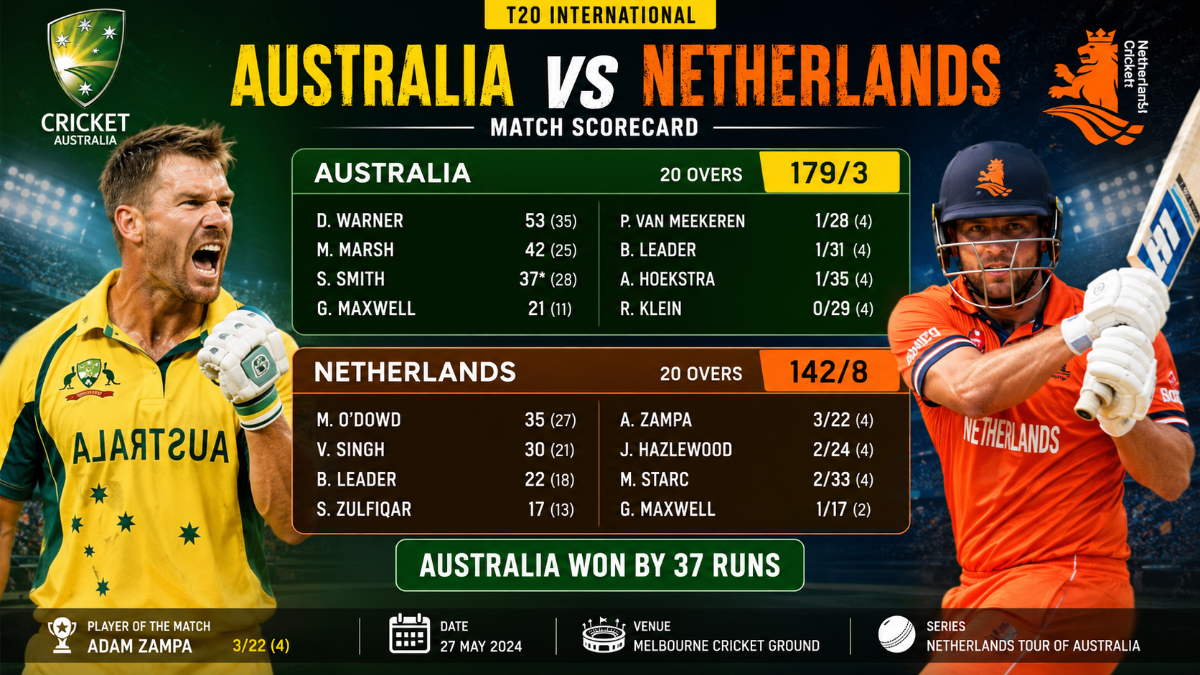
The Australian Men’s Cricket Team vs Netherlands National Cricket Team Match Scorecard from the 2023 ICC Men’s Cricket World Cup remains one of the most lopsided results in the format’s history. Played at Arun Jaitley Stadium in Delhi on October 25, 2023, Australia dismantled Netherlands by 309 runs, posting 399/8 in their allotted 50 overs before bowling out the Dutch side for a mere 90 in 21 overs. It wasn’t just a win-it was a statistical earthquake that reshaped record books and reminded the cricketing world why depth matters more than heart in 50-over cricket.This is not a story about a routine league-stage fixture. It’s the story of how a team under pressure to save its own World Cup campaign turned a must-win game into the most one-sided demolition in men’s World Cup history, powered by two centuries, a record-breaking 40-ball hundred, and a spin spell that ended the contest before it ever had a chance to breathe. Below is the full scorecard, ball-by-ball timeline, tactical analysis, and everything a serious cricket reader needs to understand why this match still gets searched years later.
Match Summary and Quick Result
Australia beat Netherlands by 309 runs in the 24th match of the 2023 ICC Men’s Cricket World Cup, the largest winning margin by runs in men’s World Cup history. At the time this match was played, Australia had lost two of their opening two fixtures and were under genuine pressure to arrest a slide that threatened their semi-final qualification. Netherlands, by contrast, had just pulled off a stunning upset over South Africa days earlier and arrived in Delhi with unexpected belief. What followed instead was a ruthless correction of form from Australia-one that also happened to produce two individual centuries and a world-record innings.
Key Match Details
| Detail | Information |
| Match | 24th Match (Day/Night), ICC Men’s Cricket World Cup 2023 |
| Date | October 25, 2023 |
| Venue | Arun Jaitley Stadium, Delhi |
| Toss | Australia won, chose to bat |
| Result | Australia won by 309 runs |
| Player of the Match | Glenn Maxwell |
| Format | 50-over ODI, Day/Night fixture |
The toss itself was a quietly important decision. Delhi pitches in October tend to offer good carry early before slowing down under lights, and Pat Cummins’ choice to bat first gave Australia the chance to exploit true bounce in the powerplay while setting a target that would force Netherlands to chase under scoreboard pressure and dew-affected conditions later in the evening.

Australia Batting Scorecard: How the Total Was Built
Australia posted 399/8 in 50 overs, built on a David Warner century, a Marnus Labuschagne cameo, and a record-shattering 40-ball hundred from Glenn Maxwell. The innings unfolded in two distinct phases. The first 40 overs were about accumulation-steady, calculated batting designed to post a competitive total without excessive risk. The final ten overs were something else entirely: a demonstration of controlled violence that turned a good total into a historic one.
Read More: Afghanistan National Cricket Team vs Canada National Cricket Team Match Scorecard
Full Batting Card
| Batter | Dismissal | Runs | Balls | 4s | 6s | Strike Rate |
| Mitchell Marsh | c Ackermann b van Beek | 9 | 15 | 2 | 0 | 60.00 |
| David Warner | c Dutt b van Beek | 104 | 93 | 11 | 3 | 111.83 |
| Steve Smith | c van der Merwe b Dutt | 71 | 68 | 9 | 1 | 104.41 |
| Marnus Labuschagne | c Dutt b de Leede | 62 | 47 | 7 | 2 | 131.91 |
| Josh Inglis (wk) | c Engelbrecht b de Leede | 14 | 12 | 1 | 1 | 116.67 |
| Glenn Maxwell | c Engelbrecht b van Beek | 106 | 44 | 9 | 8 | 240.91 |
| Cameron Green | run out | 8 | 11 | 1 | 0 | 72.73 |
| Pat Cummins (c) | not out | 12 | 9 | 2 | 0 | 133.33 |
| Mitchell Starc | c Ackermann b van Beek | 0 | 1 | 0 | 0 | 0.00 |
| Adam Zampa | not out | 1 | 1 | 0 | 0 | 100.00 |
Extras: 12 (1 nb, 11 wd) | Total: 399/8 in 50 overs (Run Rate: 7.98)
Warner’s Foundation Innings
David Warner’s 104 off 93 balls doesn’t jump off the page the way Maxwell’s innings does, but it was the platform that made everything else possible. His sixth World Cup century put him level with Sachin Tendulkar’s tally at the time, trailing only Rohit Sharma among all-time World Cup hundred-scorers. Warner played with calculated intent early-targeting width outside off stump against the new ball-before settling into a rhythm that allowed the middle order to build around him.
The Middle-Order Platform
Steve Smith’s 71 off 68 balls and Marnus Labuschagne’s quickfire 62 off 47 kept the scoreboard ticking through the middle overs without ever threatening to dominate. This is the part of the innings competitor articles routinely skip past, but it matters tactically: without Smith and Labuschagne consolidating between overs 20 and 38, Maxwell would have walked in with far less license to attack from ball one.
Fall of Wickets-Australia Innings
Australia lost wickets steadily through the middle overs before the Maxwell-Cummins stand exploded in the death overs.
- 28-1 (Marsh, 3.5 overs)
- 160-2 (Smith, 23.3 overs)
- 244-3 (Labuschagne, 36.1 overs)
- 266-4 (Inglis, 38.6 overs)
- 267-5 (Warner, 39.1 overs)
- 290-6 (Green, 42.2 overs)
- 393-7 (Maxwell, 49.3 overs)
- 393-8 (Starc, 49.4 overs)
Notice the gap between the fifth and sixth wickets falling and the total climbing from 290 to 393-that’s a jump of 103 runs in roughly seven overs, almost entirely attributable to Maxwell’s onslaught.
Netherlands Bowling Figures: Where the Damage Was Absorbed
Logan van Beek finished with the best figures for Netherlands at 4 wickets for 74 runs, but Bas de Leede absorbed the heaviest punishment, conceding 115 runs without adequate support from the field.
Bowling Breakdown
| Bowler | Overs | Runs Conceded | Wickets | Economy |
| Aryan Dutt | 7 | 59 | 1 | 8.42 |
| Colin Ackermann | 4 | 19 | 0 | 4.75 |
| Logan van Beek | 10 | 74 | 4 | 7.40 |
| Paul van Meekeren | 10 | 64 | 0 | 6.40 |
| Vikramjit Singh | 4 | 27 | 0 | 6.75 |
| Roelof van der Merwe | 5 | 41 | 0 | 8.20 |
| Bas de Leede | 10 | 115 | 2 | 11.50 |
Why De Leede’s Figures Tell a Deeper Story
Bas de Leede’s spell of 2 for 115 wasn’t a case of poor bowling in isolation-it was a captaincy decision that backfired. Scott Edwards used de Leede as the primary death-overs option, and Maxwell specifically targeted him once he identified the medium-pace lines being bowled into his arc. This is a textbook case of a bowler being exposed not through lack of skill, but through a batter’s ability to read length early and commit to the shot before the ball arrives-the single biggest skill separating elite finishers from good ones. Van Beek, by contrast, mixed his lines better and picked up the wickets of Marsh, Warner, Maxwell, and Starc-four of Australia’s top seven-showing that disciplined stump-to-stump bowling, even against a rampaging Maxwell, could still find success when the plan matched the conditions.
Netherlands Batting Scorecard: A Collapse Under Pressure
Chasing an imposing target of 400, Netherlands folded for 90 in just 21 overs, with no partnership crossing 30 runs and five different bowlers sharing the wickets. Facing the second-highest target in World Cup history, Netherlands’ batting order needed a miracle start. Instead, they lost wickets in clusters, unable to rotate strike against a disciplined Australian attack that never allowed the required run rate pressure to ease.
Full Batting Card
| Batter | Dismissal | Runs | Balls | 4s | 6s | Strike Rate |
| Vikramjit Singh | run out | 25 | 25 | 6 | 0 | 100.00 |
| Max O’Dowd | b Starc | 6 | 9 | 1 | 0 | 66.67 |
| Colin Ackermann | lbw b Hazlewood | 10 | 11 | 2 | 0 | 90.91 |
| Sybrand Engelbrecht | c Warner b Marsh | 11 | 21 | 1 | 0 | 52.38 |
| Bas de Leede | lbw b Cummins | 4 | 7 | 1 | 0 | 57.14 |
| Scott Edwards (c, wk) | not out | 12 | 22 | 0 | 0 | 54.55 |
| Teja Nidamanuru | c Inglis b Marsh | 14 | 18 | 2 | 0 | 77.78 |
| Logan van Beek | c Inglis b Zampa | 0 | 3 | 0 | 0 | 0.00 |
| Roelof van der Merwe | lbw b Zampa | 0 | 1 | 0 | 0 | 0.00 |
| Aryan Dutt | lbw b Zampa | 1 | 8 | 0 | 0 | 12.50 |
| Paul van Meekeren | st Inglis b Zampa | 0 | 1 | 0 | 0 | 0.00 |
Extras: 7 (7 wd) | Total: 90 all out in 21 overs
Vikramjit Singh’s Lone Resistance
Vikramjit Singh‘s 25 off 25 balls, laced with six boundaries, was the only innings that showed any real intent to counterattack. His run out, ironically, was the moment Netherlands’ chase effectively ended-losing their most fluent batter to a mix-up rather than a wicket-taking delivery compounded the psychological damage of an already hopeless situation.
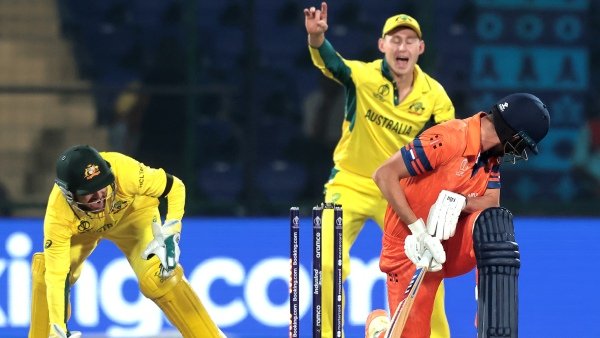
Fall of Wickets-Netherlands Innings
- 28-1 (O’Dowd, 4.5 overs)
- 37-2 (Singh, 5.5 overs)
- 47-3 (Ackermann, 9.2 overs)
- 53-4 (de Leede, 10.5 overs)
- 62-5 (Engelbrecht, 13.2 overs)
- 84-6 (Nidamanuru, 17.5 overs)
- 86-7 (van Beek, 18.3 overs)
- 86-8 (van der Merwe, 18.4 overs)
- 90-9 (Dutt, 20.5 overs)
- 90-10 (van Meekeren, 20.6 overs)
Five wickets fell for just six runs between the 17.5 and 18.4 over mark-a spell that turned a difficult chase into a formality.
Australia Bowling Figures: The Spin Trap That Ended It
Adam Zampa’s figures of 4 wickets for just 8 runs off 3 overs were the single most decisive spell of the match, ending any faint hope of a Netherlands recovery.
Bowling Breakdown
| Bowler | Overs | Runs Conceded | Wickets | Economy |
| Mitchell Starc | 4 | 22 | 1 | 5.50 |
| Josh Hazlewood | 6 | 27 | 1 | 4.50 |
| Pat Cummins | 4 | 14 | 1 | 3.50 |
| Mitchell Marsh | 4 | 19 | 2 | 4.75 |
| Adam Zampa | 3 | 8 | 4 | 2.66 |
Why Zampa’s Spell Was a Tactical Masterstroke
Cummins held Zampa back until the batting order was already destabilized-a deliberate captaincy decision rather than a reactive one. By the time Zampa was introduced, Netherlands had already lost their top four and were batting purely for survival rather than construction. Zampa exploited the pressure with tight lines around off stump, denying anything loose to cut or work through the leg side, and picked up four wickets in a spell that lasted barely 18 minutes of playing time. This is the difference between a good captain and an average one: Cummins didn’t just have five bowling options-he sequenced them to apply maximum psychological pressure at the exact moment Netherlands’ batting order was most fragile.
Playing XI: Both Squads on Match Day
Australia fielded their first-choice top order and full-strength bowling attack, while Netherlands relied on their all-round core to try and compete against a significantly deeper squad.
Australia Playing XI
Mitchell Marsh, David Warner, Steve Smith, Marnus Labuschagne, Josh Inglis (wk), Glenn Maxwell, Cameron Green, Pat Cummins (captain), Mitchell Starc, Adam Zampa, Josh Hazlewood.
Netherlands Playing XI
Vikramjit Singh, Max O’Dowd, Colin Ackermann, Bas de Leede, Teja Nidamanuru, Scott Edwards (captain, wicketkeeper), Sybrand Engelbrecht, Logan van Beek, Roelof van der Merwe, Aryan Dutt, Paul van Meekeren. The gulf in squad depth is visible in personnel alone-Australia’s line-up features five bowlers capable of taking wickets in any phase of the innings, while Netherlands leaned heavily on their all-rounders (de Leede, Ackermann, van der Merwe) to bridge the gap between bat and ball.
Match Timeline: Minute-by-Minute Momentum Shifts
The match turned decisively in the final ten overs of the Australian innings, when Glenn Maxwell scored a century off just 40 balls to set up an insurmountable total.
- Australia win the toss and elect to bat first
- 3.5 overs: Mitchell Marsh dismissed, Australia 28-1
- 23.3 overs: Steve Smith departs after a fluent 71
- 36.1 overs: Marnus Labuschagne falls after a quickfire 62
- 39.1 overs: David Warner completes his sixth World Cup century (104 off 93 balls), then falls shortly after
- 42.2 overs: Cameron Green run out, Australia 290-6
- 49.3 overs: Glenn Maxwell reaches his century off just 40 balls-the fastest century in men’s Cricket World Cup history-before being dismissed for 106 off 44
- 50.0 overs: Australia close at 399/8, one of the highest totals in their World Cup history
- 4.5 to 20.6 overs: Netherlands lose wickets in a steady, uninterrupted collapse
- 17.5 to 18.4 overs: Five wickets fall in the span of six deliveries
- 20.6 overs: Netherlands bowled out for 90, Australia win by 309 runs
Partnership Summary: The Stands That Defined the Innings
The Warner-Smith stand of 132 runs gave Australia a platform, but the unbroken Maxwell-Cummins partnership of 103 runs off just 44 balls turned a good total into a record one. Partnerships tell the real story of any ODI innings, and this match is a perfect case study in contrast. Australia built theirs in layers-Warner and Smith laying groundwork, Labuschagne accelerating, and Maxwell detonating everything in the final act. Netherlands, on the other hand, never assembled a partnership beyond 30 runs, which single-handedly explains why their innings unraveled so quickly once early wickets fell. In ODI cricket, partnerships above 50 runs typically correlate directly with a team’s ability to post competitive totals-Netherlands managed none.
Death Overs Analysis: Overs 41 to 50
Australia scored 109 runs in the final ten overs alone, with Maxwell contributing the overwhelming majority of that total at a strike rate exceeding 300. Break this down further and the numbers become even more staggering. Maxwell faced just 30 balls across this phase and scored 94 of his 106 runs within it-meaning roughly 89% of his entire innings came inside the last ten overs. His innings featured nine boundaries and eight sixes combined, meaning well over 70% of his total runs came directly from boundary hits rather than ones and twos. This boundary percentage is a critical indicator of “risk-adjusted acceleration”-Maxwell wasn’t scrambling for quick singles under pressure, he was simply clearing the ropes at will.
Australian Men’s Cricket Team vs Netherlands National Cricket Team Match Scorecard: Arun Jaitley Stadium, Delhi
Arun Jaitley Stadium has historically favored both pace and spin depending on the phase of play, making it one of the more balanced venues for high-scoring World Cup contests. Data from matches played at this venue during the tournament cycle showed pace bowlers taking wickets at an average near 34, while spin bowlers remained a consistent middle-overs threat. Zampa’s four-wicket haul in this match reinforced that trend, proving that even on a batting-friendly surface, quality spin bowling introduced at the right moment can dismantle an already pressured batting order.
Head-to-Head Record: Australia vs Netherlands in ODIs
Australia have historically dominated this fixture, and this 309-run win ranks among the two most one-sided results in the rivalry’s ODI history. The only comparable result is a 229-run Australian win recorded in Basseterre, further underscoring the significant gap in squad depth, bowling variety, and big-match batting experience between the two nations at ODI level. Netherlands’ associate status means these fixtures typically serve as points-table formalities for Australia rather than genuinely competitive contests-though Netherlands’ earlier upset over South Africa in the same tournament proved they were capable of producing shocks under the right conditions.
Comparing This to Other Historic World Cup Blowouts
To understand exactly how extreme this result was, it helps to place it in context against other lopsided World Cup results. A 309-run margin isn’t just large-it’s the largest ever recorded in men’s World Cup history by runs, surpassing previous record blowouts by a significant distance. Most one-sided World Cup results tend to occur when one team posts 350+ and dismisses the opposition inside 35 overs, this match went several steps further, with Netherlands folding in under half their allotted overs against a target nearly 310 runs beyond their capability on the day.
Individual Records That Fell in This Match
Glenn Maxwell’s 40-ball century is the headline record, but this match also produced several secondary milestones worth tracking for World Cup statistics enthusiasts.
- Fastest century in men’s Cricket World Cup history (Maxwell, 40 balls)
- Largest winning margin by runs in men’s World Cup history (309 runs)
- David Warner’s sixth World Cup century, matching one of the format’s most prolific big-match batters
- Most expensive bowling figures conceded by a Netherlands bowler in this World Cup cycle (de Leede, 2/115)
- Adam Zampa’s economy rate of 2.66 was among the tightest spells by a spinner in the tournament
Why This Match Still Matters in 2026
Even years removed from the tournament itself, this fixture continues to be searched heavily-not because of its impact on the points table, but because of the records embedded inside it. Maxwell’s 40-ball century remains the fastest in men’s World Cup history, and Australia’s 309-run margin has not been surpassed since. For fans researching historic ODI blowouts, tracking record progressions, or simply revisiting one of Maxwell’s most career-defining innings, this scorecard continues to function as a reference point rather than a forgotten league-stage result buried in tournament archives. It’s also a useful case study for younger associate nations. Netherlands’ bowling attack wasn’t poorly skilled-de Leede, van Beek, and Ackermann are all genuine international-standard cricketers-but the gap in depth becomes brutally visible once a top-order batter like Maxwell finds range against death-overs bowling that lacks variation. The lesson for associate cricket boards watching this match closely, death-overs specialization matters just as much as raw pace or control.
Frequently Asked Questions:
What was the final score of the Australian Men’s Cricket Team vs Netherlands National Cricket Team Match Scorecard?
Australia scored 399/8 in 50 overs, Netherlands were bowled out for 90 in 21 overs. Australia won by 309 runs.
Who was the Player of the Match?
Glenn Maxwell was named Player of the Match for his unbeaten-run innings of 106 off 44 balls, reaching his century in just 40 deliveries.
Where was the Australia vs Netherlands match played?
The match was played at Arun Jaitley Stadium, Delhi, on October 25, 2023.
What records were broken in this match?
Glenn Maxwell scored the fastest century in men’s Cricket World Cup history (40 balls), and Australia’s 309-run win became the largest margin by runs in men’s World Cup history.
How many centuries were scored in the match?
Two centuries were scored-David Warner’s 104 off 93 balls and Glenn Maxwell’s 106 off 44 balls.
Who took the most wickets for Netherlands?
Logan van Beek took 4 wickets for 74 runs, the best bowling figures for Netherlands in the match.
Who was the most economical Australian bowler?
Adam Zampa was the most economical, taking 4 wickets for just 8 runs off 3 overs.
Why did the Netherlands collapse so quickly while chasing?
Netherlands lost wickets in clusters without building any partnership beyond 30 runs, unable to cope with scoreboard pressure from a 400-run target.
What was Australia’s run rate in the final 10 overs?
Australia scored 109 runs in the last 10 overs, driven largely by Glenn Maxwell’s rapid century.
Is this the biggest win by runs in ODI World Cup history?
Yes, Australia’s 309-run victory over Netherlands remains the largest margin by runs in men’s Cricket World Cup history.