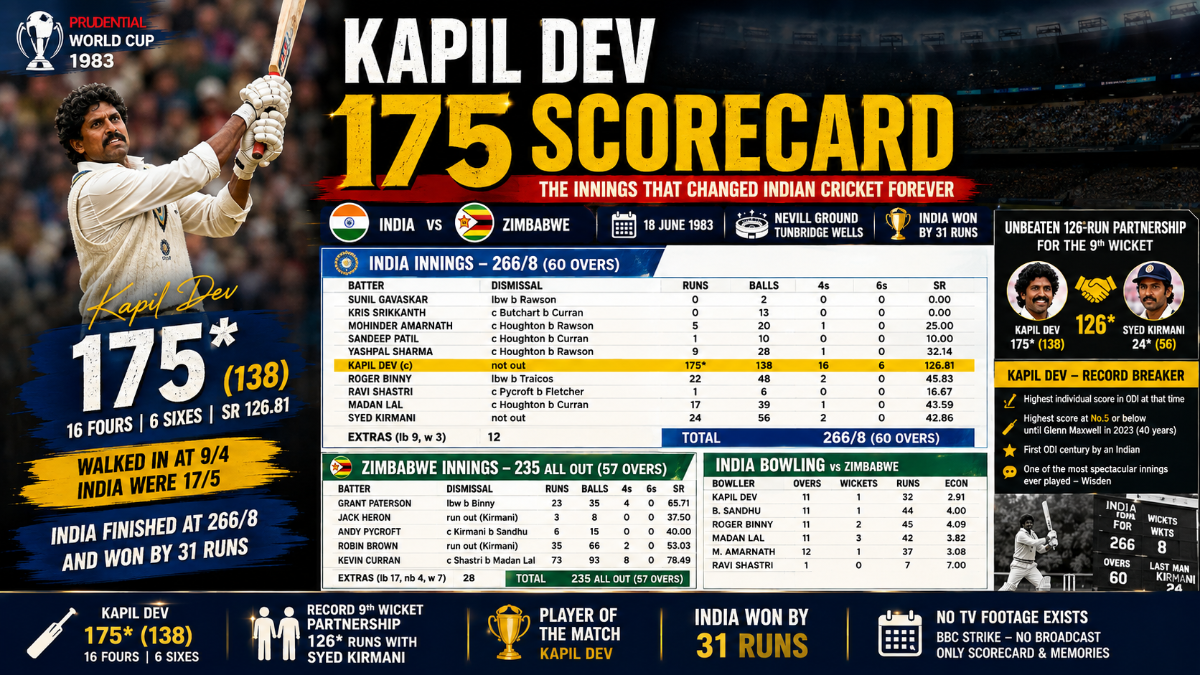
The Kapil Dev 175 Scorecard remains one of the most significant records in Cricket World Cup history, and this guide brings together everything connected to it in one place: the full batting and bowling cards for both teams, the tournament context that made the innings necessary, India’s complete 1983 World Cup campaign, and exactly how this record fits into the broader history of ODI batting. On June 18, 1983, at the Nevill Ground in Tunbridge Wells, Kapil Dev scored an unbeaten 175 off 138 balls against Zimbabwe-16 fours and six sixes built from a position of near-total collapse. No broadcast footage of it survives anywhere in the world.
Kapil Dev 175 Scorecard: Quick Snippet Answer
Kapil Dev scored an unbeaten 175 off 138 balls against Zimbabwe in the 1983 Cricket World Cup, on June 18 at Tunbridge Wells. His innings included 16 fours and six sixes and rescued India after they slipped to 17/5. India finished on 266/8, and won by 31 runs after bowling Zimbabwe out for 235. This remains the defining entry point for anyone searching the Kapil Dev 175 Scorecard.
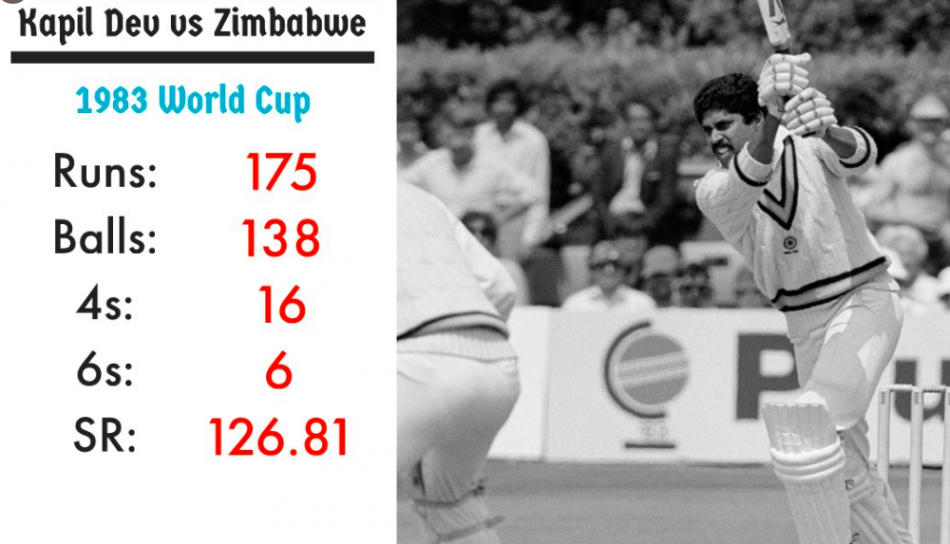
Key Numbers at a Glance
| Stat | Value |
| Runs | 175* |
| Balls | 138 |
| Fours | 16 |
| Sixes | 6 |
| Strike Rate | 126.81 |
| Opponent | Zimbabwe |
| Venue | Nevill Ground, Tunbridge Wells |
| Date | June 18, 1983 |
| India’s Total | 266/8 |
| Result | India won by 31 runs |
Match Snapshot: Setting the Scene
This match was the 20th fixture of the 1983 Prudential World Cup, played in a 60-over format that differs from today’s standard 50-over ODIs. Understanding this context matters before diving into the full Kapil Dev 175 Scorecard, since the conditions, format, and stakes were very different from modern one-day cricket.
| Detail | Information |
| Match | India vs Zimbabwe, 20th Match, Prudential World Cup 1983 |
| Date | June 18, 1983 |
| Venue | Nevill Ground, Tunbridge Wells, England |
| Toss | India won the toss and elected to bat |
| Result | India won by 31 runs |
| Player of the Match | Kapil Dev |
| India’s Total | 266/8 in 60 overs |
| Zimbabwe’s Total | 235 all out in 57 overs |
| Key Partnership | 126* between Kapil Dev and Syed Kirmani for the 9th wicket |
| Format | 60-over ODI |
India Chose to Bat First-This Detail Changes the Story
India batted first by choice, not because they were sent in. What followed wasn’t a team ambushed after losing the toss-it was Kapil Dev‘s own side collapsing to 17 for 5 having actively chosen to bat, which makes the recovery even more remarkable from a captaincy standpoint.
Read More: Ishan Kishan 200 Scorecard
The Indian Squad That Played the 1983 World Cup
India’s 1983 World Cup squad was managed by PR Man Singh and captained by Kapil Dev, with Mohinder Amarnath serving as vice-captain. The squad blended experienced campaigners like Sunil Gavaskar with emerging talents who would go on to define Indian cricket for the next decade.
| Player | Role |
| Kapil Dev (c) | All-rounder, right-arm fast-medium |
| Mohinder Amarnath (vc) | All-rounder, right-arm medium |
| Sunil Gavaskar | Opening batsman |
| Kris Srikkanth | Opening batsman |
| Dilip Vengsarkar | Top-order batsman |
| Yashpal Sharma | Middle-order batsman |
| Sandeep Patil | Batting all-rounder |
| Syed Kirmani | Wicketkeeper-batsman |
| Ravi Shastri | Batting all-rounder |
| Kirti Azad | All-rounder, off-break bowler |
| Roger Binny | All-rounder, medium-fast bowler |
| Madan Lal | All-rounder, medium-fast bowler |
| Balwinder Sandhu | Medium-fast bowler |
| Sunil Valson | Left-arm medium-fast bowler |
India Innings: Full Batting Card
India were dismissed for 266/8 in their full 60 overs, a total built almost entirely around one innings. The complete batting card below shows exactly how catastrophic the top-order collapse was before Kapil Dev’s rescue act began.
The Top-Order Collapse in Numbers
Four batters fell for a combined 15 runs before Kapil Dev even arrived at the crease with the score at 9/4. The situation deteriorated further to 17/5 soon after, meaning five wickets had fallen for just 17 runs by the time the innings’ fate rested entirely on the captain’s shoulders.
| Batter | Dismissal | Runs | Balls | 4s | 6s | SR |
| Sunil Gavaskar | lbw b Rawson | 0 | 2 | 0 | 0 | 0.00 |
| Kris Srikkanth | c Butchart b Curran | 0 | 13 | 0 | 0 | 0.00 |
| Mohinder Amarnath | c Houghton b Rawson | 5 | 20 | 1 | 0 | 25.00 |
| Sandeep Patil | c Houghton b Curran | 1 | 10 | 0 | 0 | 10.00 |
| Yashpal Sharma | c Houghton b Rawson | 9 | 28 | 1 | 0 | 32.14 |
| Kapil Dev (c) | not out | 175 | 138 | 16 | 6 | 126.81 |
| Roger Binny | lbw b Traicos | 22 | 48 | 2 | 0 | 45.83 |
| Ravi Shastri | c Pycroft b Fletcher | 1 | 6 | 0 | 0 | 16.67 |
| Madan Lal | c Houghton b Curran | 17 | 39 | 1 | 0 | 43.59 |
| Syed Kirmani | not out | 24 | 56 | 2 | 0 | 42.86 |
| Extras | (lb 9, w 3) | 12 | ||||
| Total | 8 wickets | 266 | 60 overs | 4.43 RPO |
Balwinder Sandhu did not bat. Dilip Vengsarkar, Kirti Azad, and Sunil Valson were not part of the playing XI for this match.
Fall of wickets: 0-1 (Gavaskar), 6-2 (Srikkanth), 6-3 (Amarnath), 9-4 (Patil), 17-5 (Yashpal Sharma), 77-6 (Binny), 78-7 (Shastri), 140-8 (Madan Lal)
Kapil Dev’s Share of the Total
Kapil Dev’s 175 accounted for 65.8% of India’s entire total. His unbeaten 126-run stand with Kirmani made up 47.4% of the innings on its own-the rest of the team, across ten wickets, managed only 91 runs between them.
Zimbabwe’s Bowling in India’s Innings
Peter Rawson finished with 3 for 47 off 12 overs, and Kevin Curran took 3 for 65 off 12 overs, sharing six of India’s eight wickets between them. Both bowlers operated with real discipline against everyone except Kapil Dev himself.
Why Rawson’s Figures Deserve More Credit
Rawson’s four maidens in twelve overs is a genuinely strong return against a 266-run total. Zimbabwe’s bowlers didn’t collapse or bowl poorly-one batter simply produced an innings that transcended otherwise competent bowling.
| Bowler | Overs | Maidens | Runs | Wickets | Economy |
| Peter Rawson | 12 | 4 | 47 | 3 | 3.92 |
| Kevin Curran | 12 | 1 | 65 | 3 | 5.42 |
| Iain Butchart | 12 | 2 | 38 | 0 | 3.17 |
| Duncan Fletcher | 12 | 2 | 59 | 1 | 4.92 |
| John Traicos | 12 | 0 | 45 | 1 | 3.75 |
Zimbabwe Innings: Full Batting Card
Zimbabwe were bowled out for 235 in 57 overs, falling 31 runs short despite a fighting innings from Kevin Curran. This half of the scorecard is often overlooked, but it shows Zimbabwe were competitive throughout rather than a pushover chasing an impossible target.
Grant Paterson’s Start and the Middle-Overs Squeeze
Grant Paterson’s 23 off 35 balls gave Zimbabwe a reasonable platform, but regular wickets through the middle overs meant Zimbabwe were consistently chasing the game’s rhythm rather than dictating it.
| Batter | Dismissal | Runs | Balls | 4s | 6s | SR |
| Grant Paterson | lbw b Binny | 23 | 35 | 4 | 0 | 65.71 |
| Jack Heron | run out (Kirmani) | 3 | 8 | 0 | 0 | 37.50 |
| Andy Pycroft | c Kirmani b Sandhu | 6 | 15 | 0 | 0 | 40.00 |
| Robin Brown | run out (Kirmani) | 35 | 66 | 2 | 0 | 53.03 |
| Dave Houghton | lbw b Madan Lal | 17 | 35 | 2 | 0 | 48.57 |
| Duncan Fletcher | c Kapil Dev b Amarnath | 13 | 23 | 0 | 0 | 56.52 |
| Iain Butchart | b Binny | 18 | 43 | 1 | 0 | 41.86 |
| Gerald Peckover | c Yashpal Sharma b Madan Lal | 14 | 18 | 0 | 0 | 77.78 |
| Kevin Curran | c Shastri b Madan Lal | 73 | 93 | 8 | 0 | 78.49 |
| John Traicos | c & b Kapil Dev | 3 | 7 | 0 | 0 | 42.86 |
| Peter Rawson | not out | 2 | 6 | 0 | 0 | 33.33 |
| Extras | (lb 17, nb 4, w 7) | 28 | ||||
| Total | All out | 235 | 57 overs | 4.12 RPO |
Fall of wickets: 1-44 (Paterson), 2-48 (Heron), 3-61 (Pycroft), 4-86 (Brown), 5-103 (Houghton), 6-113 (Fletcher), 7-168 (Butchart), 8-189 (Peckover), 9-230 (Curran), 10-235 (Traicos)
Kevin Curran’s Fight and Its Limits
Curran’s 73 off 93 balls kept Zimbabwe’s chase alive well past the halfway mark, including eight fours and a crucial ninth-wicket stand that pushed the total from 189 to 230. Once Madan Lal had him caught by Ravi Shastri, the innings folded quickly. Fittingly, Kapil Dev closed out the match himself, taking a catch-and-bowl to dismiss John Traicos.
India’s Bowling in Zimbabwe’s Innings
Madan Lal finished with 3 for 42 off 11 overs, and Roger Binny took 2 for 45, forming the backbone of India’s bowling effort as they defended their total.
| Bowler | Overs | Maidens | Runs | Wickets | Economy |
| Kapil Dev | 11 | 1 | 32 | 1 | 2.91 |
| Balwinder Sandhu | 11 | 2 | 44 | 1 | 4.00 |
| Roger Binny | 11 | 2 | 45 | 2 | 4.09 |
| Madan Lal | 11 | 2 | 42 | 3 | 3.82 |
| Mohinder Amarnath | 12 | 1 | 37 | 1 | 3.08 |
| Ravi Shastri | 1 | 0 | 7 | 0 | 7.00 |
How Kapil Dev Rebuilt the Innings
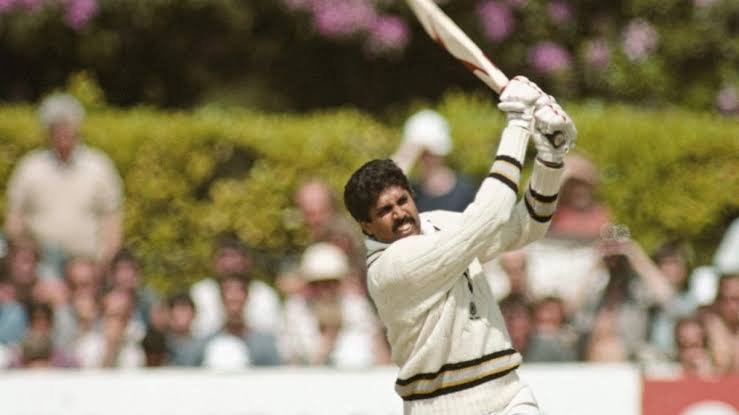
Kapil Dev’s innings evolved in stages rather than exploding from the first ball. He initially played with caution, absorbing pressure while wickets fell around him, before accelerating dramatically once the innings had stabilized.
The Acceleration Phase and the Natraj Shot
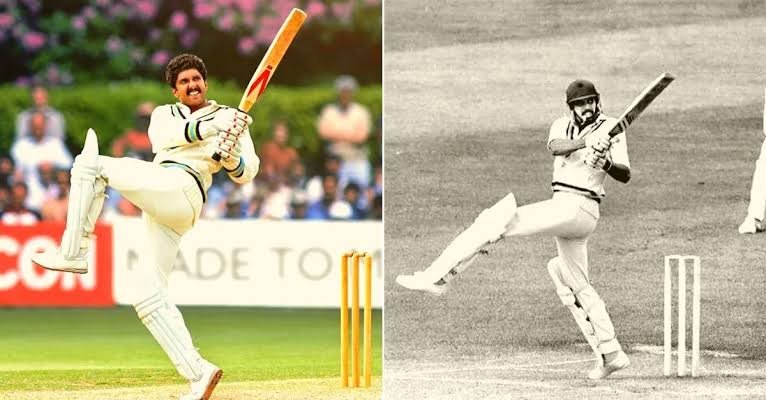
By most contemporary accounts, roughly 75 of his 175 runs came in the final 11 overs. His shot-making that day became cricketing folklore, including the now-famous “Natraj shot”-a mid-air, one-legged pull later dramatized in Bollywood retellings of the innings.
The Kirmani Partnership That Changed ODI History
Kapil Dev and Syed Kirmani added an unbeaten 126 runs for the ninth wicket, a stand that stood as the highest ninth-wicket partnership in ODI cricket for 27 years. Kirmani’s unbeaten 24 off 56 balls wasn’t about scoring fast-it was about staying out of the way and giving Kapil Dev the strike.
India’s Complete 1983 World Cup Campaign
Kapil Dev’s 175 was the centerpiece of a six-match group campaign that saw India finish second in Group B behind West Indies, before an upset run through the knockouts delivered the trophy. Seeing the full campaign in context shows exactly how much this single innings mattered to the bigger picture.
Also Read: Sydney Sixers vs Melbourne Stars Match Scorecard
| Match | Date | Opponent | Result |
| Match 1 | June 9, 1983 | West Indies | India won by 34 runs |
| Match 2 | June 11, 1983 | Zimbabwe | India won by 5 wickets |
| Match 3 | June 13, 1983 | Australia | India lost by 162 runs |
| Match 4 | June 15, 1983 | West Indies | India lost by 66 runs |
| Match 5 | June 18, 1983 | Zimbabwe | India won by 31 runs (Kapil Dev’s 175*) |
| Match 6 | June 20, 1983 | Australia | India won by 118 runs |
| Semifinal | June 22, 1983 | England | India won by 6 wickets |
| Final | June 25, 1983 | West Indies | India won by 43 runs |
Why This Innings Mattered for India’s World Cup Campaign
India had lost their previous match to West Indies by 66 runs before facing Zimbabwe on June 18. Coming off that defeat, a second consecutive loss-especially to a team India had already beaten once in the group stage-would have significantly damaged their semifinal chances. The victory kept India’s campaign firmly on track, and they closed the group stage with a dominant 118-run win over Australia before beating hosts England in the semifinal and West Indies in the final at Lord’s.
The win was crucial to India’s semifinal push rather than a strict tournament-eliminating must-win game in mathematical terms-but the psychological cost of a second defeat to Zimbabwe, coming right after losing to West Indies, would have been considerable heading into the business end of the tournament.
Why No Video Footage of This Innings Exists
No broadcast footage of Kapil Dev’s 175 survives anywhere. The Nevill Ground match was not televised. Retrospective accounts commonly attribute this to a BBC industrial dispute combined with the corporation’s limited camera resources being assigned to the West Indies vs Australia fixture being played the same day. What remains today is the official scorecard, contemporary newspaper reports, photographs, and the accounts of those present.
Where Kapil Dev’s 175 Sits in ODI Record History
Kapil Dev’s 175 broke a record that had stood for eight years, and it was itself broken less than a year later-a detail that surprises many people who assume it stood for decades. Tracking the record’s full progression puts the achievement in sharper historical focus.
The Full Record Progression
| Player | Score | Opponent | Year | Record Duration |
| Glenn Turner | 171* | East Africa | 1975 | 8 years |
| Kapil Dev | 175* | Zimbabwe | 1983 | 348 days |
| Viv Richards | 189* | England | 1984 | 12 years, 355 days |
| Saeed Anwar | 194 | India | 1997 | 12 years |
| Charles Coventry | 194* | Bangladesh | 2009 | Equaled record |
| Sachin Tendulkar | 200* | South Africa | 2010 | Under 2 years |
| Virender Sehwag | 219 | West Indies | 2011 | 3 years |
| Rohit Sharma | 264 | Sri Lanka | 2014 | Current record |
Kapil Dev’s 175 held the outright highest ODI score record for only 348 days, before Viv Richards’ famous 189 not out against England surpassed it in May 1984. What has lasted far longer is a more specific record: the highest score by a batter at number five or lower, which Kapil Dev held for exactly 40 years until Glenn Maxwell broke it in the 2023 Cricket World Cup. These are two different records, and conflating them is a common error in retellings of this innings.
A Curious Coincidence: Virender Sehwag’s Identical Score
Virender Sehwag scored exactly 175 in a 2011 World Cup match against Bangladesh, matching Kapil Dev’s number precisely, though off 140 balls rather than 138 and without the not-out distinction. It’s a remarkable numerical coincidence connecting two of India’s most explosive World Cup innings, separated by 28 years.
Records Set and Broken by Kapil Dev’s 175
This was the highest individual score in ODI cricket at the time it was played, and it was also the first ODI century scored by an Indian batter. Wisden described the match as containing “one of the most spectacular innings played in this form of cricket,” a rare superlative from a publication not known for hyperbole.
Fastest ODI Century of Its Era
Kapil Dev’s innings is also recorded among historical lists as one of the fastest ODI centuries up to that point, reflecting how far ahead of its time the acceleration phase of his innings really was, given the bats, boundary sizes, and fielding restrictions of 1983 cricket.
Frequently Asked Questions:
What is Kapil Dev’s 175 scorecard?
Kapil Dev scored 175 not out off 138 balls, with 16 fours and six sixes, against Zimbabwe in the 1983 Prudential World Cup, guiding India to 266/8 in 60 overs.
Who won the toss in the Kapil Dev 175 match?
India won the toss and elected to bat first.
Against which team did Kapil Dev score 175?
Kapil Dev scored his 175 not out against Zimbabwe, on June 18, 1983, at the Nevill Ground in Tunbridge Wells.
Is there video footage of Kapil Dev’s 175?
No broadcast footage survives. The match wasn’t televised, and retrospective accounts commonly attribute this to a BBC strike and camera resources being assigned to a different World Cup fixture that day.
What was India’s score when Kapil Dev came in to bat?
India were 9 for 4 when Kapil Dev walked in, and the score soon slipped to 17 for 5 before he began rebuilding the innings.
Who did Kapil Dev partner with for his record partnership?
Kapil Dev added an unbeaten 126 runs with wicketkeeper Syed Kirmani for the ninth wicket-a stand that stood as an ODI record for 27 years.
Did India win the match where Kapil Dev scored 175?
Yes. India won by 31 runs, restricting Zimbabwe to 235 all out in 57 overs after posting 266/8.
How long did Kapil Dev’s 175 remain the outright highest ODI score?
Only 348 days-Viv Richards surpassed it with 189* against England in May 1984. Kapil Dev’s separate record for the highest score at number five or lower lasted 40 years, until Glenn Maxwell broke it in 2023.
What percentage of India’s total did Kapil Dev score?
His 175 accounted for 65.8% of India’s 266-run total.
Why is Kapil Dev’s 175 significant for India’s 1983 World Cup campaign?
It came right after India had lost to the West Indies, and a second consecutive defeat would have hurt their semifinal push. India went on to finish second in Group B and win the tournament, beating England in the semifinal and West Indies in the final.
Who else has scored exactly 175 in a Cricket World Cup match?
Virender Sehwag scored 175 (off 140 balls) against Bangladesh in the 2011 World Cup, matching Kapil Dev’s number exactly, though not unbeaten.
What record did Kapil Dev’s 175 break?
It broke Glenn Turner’s 171 not out against East Africa in 1975, which had stood for eight years.
Who managed the Indian team during the 1983 World Cup?
PR Man Singh served as team manager, with Kapil Dev as captain and Mohinder Amarnath as vice-captain.