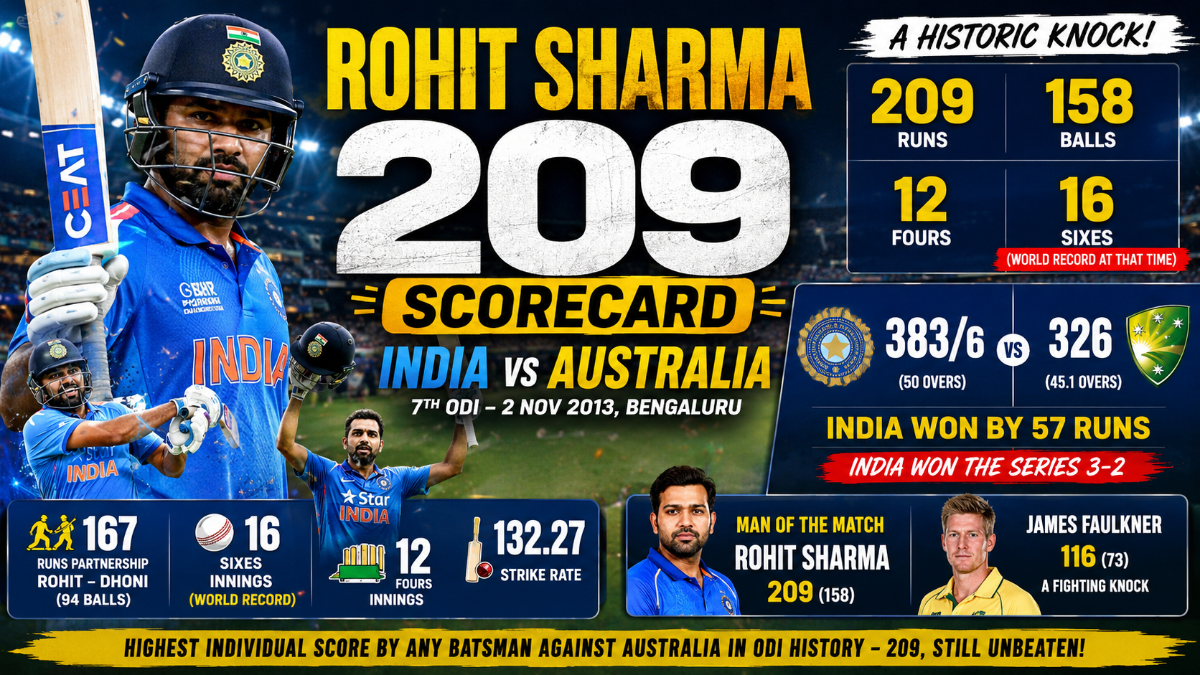
The Rohit Sharma 209 Scorecard shows Rohit Sharma scoring 209 runs off 158 balls, with 12 fours and a then-world-record 16 sixes, as India posted 383 for 6 and beat Australia by 57 runs in the series-deciding 7th ODI at Bangalore on 2 November 2013. The win sealed India’s series victory 3-2 and made Rohit only the third batsman in ODI history, after Sachin Tendulkar and Virender Sehwag, to score a double century.
Anyone searching the Rohit Sharma 209 Scorecard usually wants three things fast: the full batting and bowling figures, the exact sequence of how the innings was built, and how this knock compares to the handful of other ODI double centuries in history. This article covers all three using verified match data, without inflating a single number for effect.
Match Overview: India vs Australia, 7th ODI 2013
India beat Australia by 57 runs at the M Chinnaswamy Stadium in Bangalore on 2 November 2013, with Rohit Sharma’s 209 anchoring a total of 383 for 6 in the series-deciding match.
Australia won the toss and chose to field first, backing their bowling attack to defend a modest target on a small ground with fast outfield conditions. That decision unraveled almost completely once Rohit Sharma’s innings shifted from cautious accumulation to outright destruction in the back half of the innings. The result handed India a 3-2 series win and remains one of the most complete case studies in ODI batting acceleration.
Key Match Details
| Detail | Information |
| Match | 7th ODI, Australia tour of India 2013-14 |
| Date | 2 November 2013 |
| Venue | M Chinnaswamy Stadium, Bangalore |
| Toss | Australia won, elected to field |
| Result | India won by 57 runs |
| Series result | India won 3-2 |
| Player of the Match | Rohit Sharma |
Every detail here is drawn from the official Rohit Sharma 209 Scorecard making this match one of the most searched entry points into ODI record-book history.
The Untold Origin: How Rohit Sharma Became an Opener
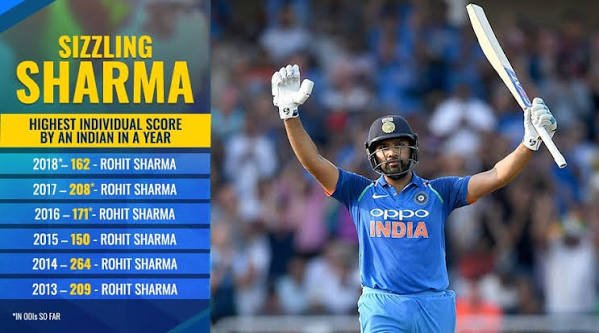
Rohit Sharma was promoted to open the batting only months before this innings, first during the 2013 Champions Trophy at MS Dhoni‘s suggestion, after struggling for consistency in the middle order for nearly five years.
Before this Rohit Sharma 209 Scorecard became historic, Rohit’s career told a very different story. Across his first 88 ODI innings batting in the middle order, he had scored just two centuries and averaged 30.82-a solid but unremarkable record for a player many still considered supremely talented but chronically inconsistent.
The Conversation That Changed Everything
According to accounts from India’s 2013 Champions Trophy campaign, then-captain MS Dhoni approached Rohit during a warm-up match after the designated openers failed to fire, asking simply: “Opening khelega kya?” (Will you open?). Rohit agreed, and the move was made permanent by the time Australia toured India later that year-setting up the exact circumstances that produced this scorecard.
Also Read: Ishan Kishan 200 Scorecard
Career Before vs After the Move to Open
| Period | Matches | Runs | Average | Centuries | Highest Score |
| Before opening (middle order) | 88 | – | 30.82 | 2 | – |
| 2013 alone (after promotion) | 28 | 1,196 | 52.00 | 2 | 209 |
The numbers make the tactical gamble obvious in hindsight: in the same calendar year he was moved to open, Rohit scored 1,196 runs at an average of 52.00, including the very innings covered in this scorecard. The 209 wasn’t an isolated fluke-it was the clearest early signal that the positional change had unlocked a different level of batting entirely.
Full Scorecard: India Innings-383 for 6 (50 overs)
India were bowled out for 383 for 6, built almost entirely around Rohit Sharma’s 209, with useful contributions of 60 from Shikhar Dhawan and 62 from MS Dhoni.
Opening the innings alongside Shikhar Dhawan, Rohit began cautiously, absorbing early pressure while his partner attacked from the other end. Dhawan’s fifty came off 43 balls, while Rohit needed 71 deliveries to reach the same landmark-a fact that surprises most readers encountering the full Rohit Sharma 209 Scorecard for the first time.
Full Batting Card
| Batter | Dismissal | Runs | Balls | 4s | 6s | SR |
| Shikhar Dhawan | lbw b Doherty | 60 | 57 | 9 | 0 | 105.26 |
| Rohit Sharma | c sub (Henriques) b McKay | 209 | 158 | 12 | 16 | 132.27 |
| Virat Kohli | run out (Coulter-Nile/Haddin) | 0 | 4 | 0 | 0 | 0.00 |
| Suresh Raina | lbw b Doherty | 28 | 30 | 2 | 0 | 93.33 |
| Yuvraj Singh | c Haddin b Faulkner | 12 | 14 | 0 | 1 | 85.71 |
| MS Dhoni (c & wk) | run out | 62 | 38 | 7 | 2 | 163.15 |
| Ravindra Jadeja | not out | 0 | 2 | 0 | 0 | 0.00 |
| Extras | (lb 5, w 7) | 12 | – | – | – | – |
| Total | 6 wickets, 50 overs | 383 | 21 | 19 | 7.66 |
Fall of wickets: 1-112 (Dhawan, 18.6 ov), 2-113 (Kohli, 19.5 ov), 3-185 (Raina, 29.3 ov), 4-207 (Yuvraj, 33.5 ov), 5-374 (Rohit, 49.3 ov), 6-383 (Dhoni, 49.6 ov)
Why Kohli’s Dismissal Barely Mattered
Virat Kohli was run out for a duck off just 4 balls, but the setback barely dented India’s total because Rohit Sharma immediately found a new scoring partner in Suresh Raina.
A run-out so early in the innings would normally trigger a batting collapse. Instead, it became a footnote, because Rohit Sharma had already begun absorbing the bulk of the strike-a pattern that continued for the rest of the innings regardless of which partner joined him at the other end.
India Innings Partnerships
| Wicket | Pair | Runs |
| 1st | Dhawan–Rohit | 112 |
| 2nd | Rohit–Kohli | 1 |
| 3rd | Rohit–Raina | 72 |
| 4th | Rohit–Yuvraj | 22 |
| 5th | Rohit–Dhoni | 167 |
| 6th | Dhoni–Jadeja | 9 |
The 167-run partnership between Rohit and Dhoni, compiled off just 94 balls, stands as the defining stand of the innings-built at more than 10 runs per over against tiring bowlers.
Australia’s Bowling Figures
| Bowler | Overs | Maidens | Runs | Wickets | Economy |
| Clint McKay | 10 | 0 | 89 | 1 | 8.90 |
| Nathan Coulter-Nile | 10 | 0 | 80 | 0 | 8.00 |
| James Faulkner | 10 | 0 | 75 | 1 | 7.50 |
| Shane Watson | 5 | 0 | 26 | 0 | 5.20 |
| Xavier Doherty | 10 | 0 | 74 | 2 | 7.40 |
| Glenn Maxwell | 4 | 0 | 32 | 0 | 8.00 |
| Aaron Finch | 1 | 0 | 2 | 0 | 2.00 |
No Australian bowler apart from Finch’s single over and Watson’s short burst finished with an economy under 7-a clear numerical signal of how completely the batting dictated terms.
The Bowling Attack Rohit Faced That Day
Australia’s bowling attack combined express pace in Nathan Coulter-Nile and Clint McKay with the off-spin variations of Xavier Doherty and Glenn Maxwell-a mix Rohit dismantled differently depending on the bowling style.
Rohit’s scoring split tells its own story: against the pace bowlers, he relied on timing and placement through the off side, while against the spin duo of Doherty and Maxwell, he went almost exclusively for the boundary, scoring at a materially higher rate. This mixed-method approach against two different bowling styles in the same innings is part of why the knock is still referenced in coaching discussions about adapting technique mid-innings rather than relying on a single scoring method throughout.
Run Progression: How Rohit Built His 209
Rohit Sharma’s innings unfolded in four distinct phases-a slow 71-ball fifty, a steady build to his century in 114 balls, an aggressive middle phase, and an explosive final burst of 59 runs off just 18 balls.
The Cautious Opening Phase
Rohit’s first fifty runs took 71 deliveries-barely a run a ball against a bowling attack that included genuine pace in Coulter-Nile and McKay. This phase is routinely skipped in highlight reels, but it’s essential context: the explosive finish only became possible because he preserved his wicket early.
The Controlled Build to a Century
His century arrived off 114 balls, meaning the second fifty took just 43 deliveries-roughly double the scoring rate of his first fifty. This is the phase where Rohit began targeting Australia’s spin options, Xavier Doherty and Glenn Maxwell, almost exclusively for boundaries.
The Explosive Finish
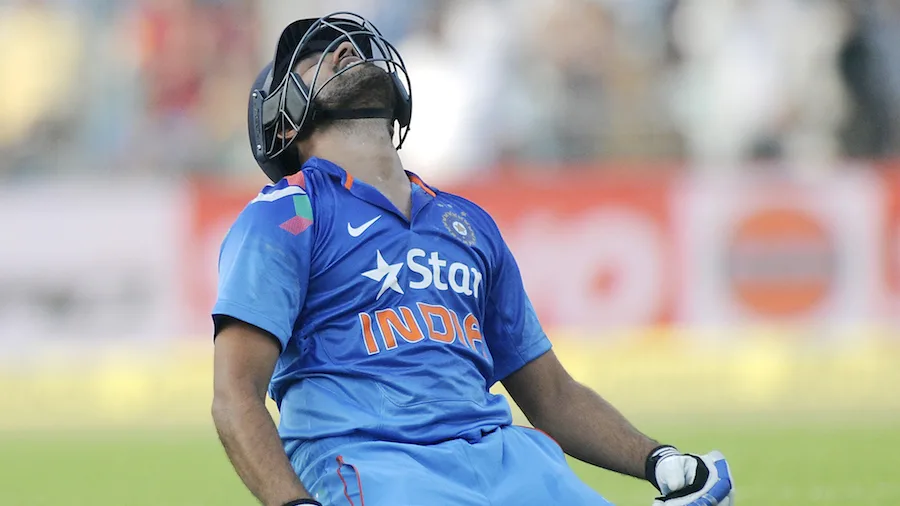
From 150 to his eventual dismissal on 209, Rohit needed just 18 balls, having reached 150 off 140 deliveries and 200 off 156. That means his final 59 runs came from his last 18 scoring opportunities-the most extreme acceleration phase of any ODI double century on record.
Milestone Timeline
| Milestone | Balls Faced |
| 50 | 71 |
| 100 | 114 |
| 150 | 140 |
| 200 | 156 |
| 209 (out) | 158 |
This breakdown is the single most useful addition any Rohit Sharma 209 Scorecard resource can offer, because it explains the “how” behind a number that otherwise just looks impressive on paper.
Full Scorecard: Australia Innings-326 All Out (45.1 overs)
Australia were bowled out for 326, with James Faulkner‘s maiden ODI century of 116 off 73 balls and a stunning 115-run ninth-wicket stand briefly threatening an improbable chase.
Chasing 384, Australia’s top order collapsed early, losing three wickets inside the first 16 overs. James Faulkner’s counter-attacking century turned what looked like a formality into a genuinely tense finish before India closed out the match.
Full Batting Card
| Batter | Dismissal | Runs | Balls |
| Aaron Finch | lbw b Shami | 5 | 5 |
| Phillip Hughes | c Yuvraj b Shami | 23 | 33 |
| Brad Haddin | b Ashwin | 40 | 49 |
| George Bailey | run out | 4 | 12 |
| Adam Voges | b Shami | 4 | 14 |
| Glenn Maxwell | c Jadeja b Ashwin | 60 | 22 |
| James Faulkner | c Dhawan b Shami | 116 | 73 |
| Shane Watson | c sub b Jadeja | 49 | 22 |
| Nathan Coulter-Nile | c Kohli b Jadeja | 3 | 5 |
| Clint McKay | b Jadeja | 18 | 37 |
| Xavier Doherty | not out | 0 | 0 |
| Extras | (lb 1, w 2, nb 1) | 4 | – |
| Total | All out, 45.1 overs | 326 |
Fall of wickets: 1-7 (Finch), 2-64 (Hughes), 3-70 (Bailey), 4-74 (Haddin), 5-132 (Voges), 6-138 (Maxwell), 7-205 (Watson), 8-211 (Coulter-Nile), 9-326 (McKay), 10-326 (Faulkner)
The Faulkner Fightback That Nearly Rewrote the Ending
Australia slipped to 211 for 8 before James Faulkner and Clint McKay added 115 runs for the ninth wicket, the closest Australia came to chasing down 384.
At 211/8, the match looked settled in India’s favor. Faulkner’s 73-ball century, laced with 11 fours and 6 sixes, briefly threatened to complete one of the great chases in ODI history. Ravindra Jadeja eventually broke the stand, and Shikhar Dhawan completed a diving catch at deep midwicket off Mohammed Shami to end the innings.
Read More: Kapil Dev 175 Scorecard
India Bowling Figures
| Bowler | Overs | Maidens | Runs | Wickets | Economy |
| Bhuvneshwar Kumar | 8 | 1 | 47 | 0 | 5.87 |
| Mohammed Shami | 8.1 | 0 | 52 | 3 | 6.36 |
| Vinay Kumar | 9 | 0 | 102 | 1 | 11.33 |
| Ravichandran Ashwin | 10 | 0 | 51 | 2 | 5.10 |
| Ravindra Jadeja | 10 | 0 | 73 | 3 | 7.30 |
Australia Innings Partnerships
| Wicket | Pair | Runs |
| 1st | Finch–Hughes | 7 |
| 2nd | Haddin–Hughes | 57 |
| 3rd | Haddin–Bailey | 6 |
| 4th | Haddin–Voges | 4 |
| 5th | Voges–Maxwell | 58 |
| 6th | Faulkner–Maxwell | 6 |
| 7th | Watson–Faulkner | 67 |
| 8th | Coulter-Nile–Faulkner | 6 |
| 9th | McKay–Faulkner | 115 |
| 10th | Doherty–Faulkner | 0 |
Complete Match Statistics at a Glance
India scored 383 for 6 at a run rate of 7.66, while Australia managed 326 all out at 7.21-a closer contest by run rate than the 57-run margin suggests.
| Statistic | India | Australia |
| Total | 383/6 | 326 all out |
| Overs | 50.0 | 45.1 |
| Run Rate | 7.66 | 7.21 |
| Highest Individual Score | 209 (Rohit) | 116 (Faulkner) |
| Highest Partnership | 167 (5th wicket) | 115 (9th wicket) |
| Best Bowling Figures | 2/74 (Doherty) | 3/52 (Shami) |
| Extras | 12 | 4 |
Where This Innings Ranks Among ODI History’s Biggest Totals
India’s 383 for 6 was one of the highest ODI totals posted against Australia at the time, though it sits outside the all-time top 10 team totals, which are now led by England’s 498 for 4.
Context matters when evaluating any big total, and the Rohit Sharma 209 Scorecard is best understood alongside how ODI scoring has evolved since 2013.
| Rank | Team | Score | Opponent | Year |
| 1 | England | 498/4 | Netherlands | 2022 |
| 2 | England | 481/6 | Australia | 2018 |
| 3 | England | 444/3 | Pakistan | 2016 |
| 4 | Sri Lanka | 443/9 | Netherlands | 2006 |
| 5 | South Africa | 439/2 | West Indies | 2015 |
| 6 | South Africa | 438/4 | India | 2015 |
| 7 | Australia | 434/4 | South Africa | 2006 |
| – | India | 383/6 | Australia | 2013 (this match) |
India’s highest-ever ODI total remains 418 for 5, scored against West Indies in 2011-meaning this 383 wasn’t even India’s own record, but it was comfortably enough to beat one of the format’s most fearsome batting line-ups on the day. Scores in the high 300s and 400s have become steadily more common since 2013, partly because of exactly the kind of aggressive batting approach this innings helped popularize.
Rohit’s 209 Compared to Every Other ODI Double Century
Snippet summary: Rohit Sharma’s 209 has the fewest fours and the most sixes of any ODI double century, reflecting a scoring method built on clearing the boundary rather than finding gaps in the field.
| Player | Score | Balls | 4s | 6s | Against | Year |
| Sachin Tendulkar | 200* | 147 | 25 | 3 | South Africa | 2010 |
| Virender Sehwag | 219 | 149 | 25 | 7 | West Indies | 2011 |
| Rohit Sharma | 209 | 158 | 12 | 16 | Australia | 2013 |
| Rohit Sharma | 264 | 173 | 33 | 9 | Sri Lanka | 2014 |
What Makes the 209 Statistically Unique
Among all four ODI double-century innings by Indian batsmen, Rohit’s 209 relied more heavily on sixes than any other, with 16 maximums compared to a maximum of 9 in any other double hundred.
This detail is frequently missed in retellings that only compare final scores. The 209 wasn’t built the same way as Sehwag’s 219 or Rohit’s own later 264-both of those innings relied more on placement and running between the wickets, while the 209 was constructed disproportionately through clean hitting over the boundary.
Tactical Context: Why the Small Ground Mattered
The M Chinnaswamy Stadium’s short square boundaries and fast outfield played a direct role in Rohit’s six-hitting, particularly against Australia’s spin options in the middle overs.
Ground dimensions rarely get enough credit in scorecard analysis, but this venue’s compact square boundaries meant that mistimed shots which would be caught on a larger ground instead cleared the rope. Rohit exploited this directly, particularly against Xavier Doherty and part-time bowler Glenn Maxwell, repeatedly picking the shorter side of the ground for his six-hitting.
Records Broken by This Innings
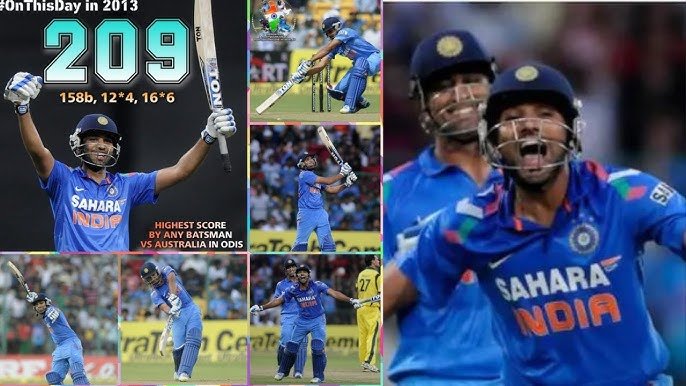
- Most sixes in a single ODI innings: 16, surpassing the previous record of 15 held by Shane Watson
- Highest individual ODI score by any batsman against Australia: 209, a record that still stands
- Only the third double century in the format’s history at the time it was scored
- One of the fastest 150-run stands in ODI history, built by Rohit and Dhoni in 88 balls
Legacy: Why This Scorecard Still Matters
This innings marked the true beginning of Rohit Sharma’s identity as an ODI opener, a role in which he would go on to score two more double centuries and become one of the format’s most prolific run-scorers.
Following this match, Rohit went on to break his own six-hitting record and score the highest individual score in ODI history-264 against Sri Lanka in 2014. Cricket analysts and former players have since pointed to this Bangalore innings as the moment India’s team management fully committed to Rohit as a permanent opener rather than a middle-order rotation option. Since establishing himself in that role from mid-2013 onward, Rohit built one of the most productive opening careers in ODI history, a trajectory this specific scorecard set in motion.
The innings also reshaped how Indian team management approached the opening slot for the rest of the decade, prioritizing batters capable of transitioning from careful starts to explosive finishes rather than committing to all-out aggression from ball one-a template T20 cricket would later formalize as the “powerplay-to-death-overs” scoring curve.
Frequently Asked Questions
How many balls did Rohit Sharma take to score 209?
Rohit Sharma scored 209 runs off 158 balls, hitting 12 fours and 16 sixes at a strike rate of 132.27.
What is the complete Rohit Sharma 209 Scorecard result?
India scored 383 for 6 in 50 overs, Australia were bowled out for 326 in 45.1 overs. India won by 57 runs.
Who dismissed Rohit Sharma during his 209-run innings?
Who dismissed Rohit Sharma during his 209-run innings?
Clint McKay took the wicket, with substitute fielder Moises Henriques completing the catch.
How many sixes did Rohit Sharma hit in this innings?
He hit 16 sixes, a world record for the most sixes in a single ODI innings at the time.
Who was Rohit Sharma’s most important batting partner during the 209?
MS Dhoni, with whom Rohit added 167 runs off 94 balls for the fifth wicket.
Did Australia come close to chasing down India’s total?
Yes. James Faulkner’s 116 and a 115-run ninth-wicket stand with Clint McKay briefly threatened the chase before India closed out the win.
Is Rohit Sharma’s 209 still the highest ODI score against Australia?
Yes, it remains the highest individual score by any batsman against Australia in ODI history.
How does the 209 compare to Rohit’s 264 against Sri Lanka?
The 264 featured more fours (33 vs 12) but fewer sixes (9 vs 16), and came off 173 balls compared to 158 for the 209.
How many ODI double centuries has Rohit Sharma scored in his career?
Three-more than any other batsman in ODI history.
Why was Rohit Sharma opening the innings in this match?
He had been promoted to open the batting earlier in 2013 at MS Dhoni’s suggestion, a positional change that directly enabled this innings and transformed his career trajectory.