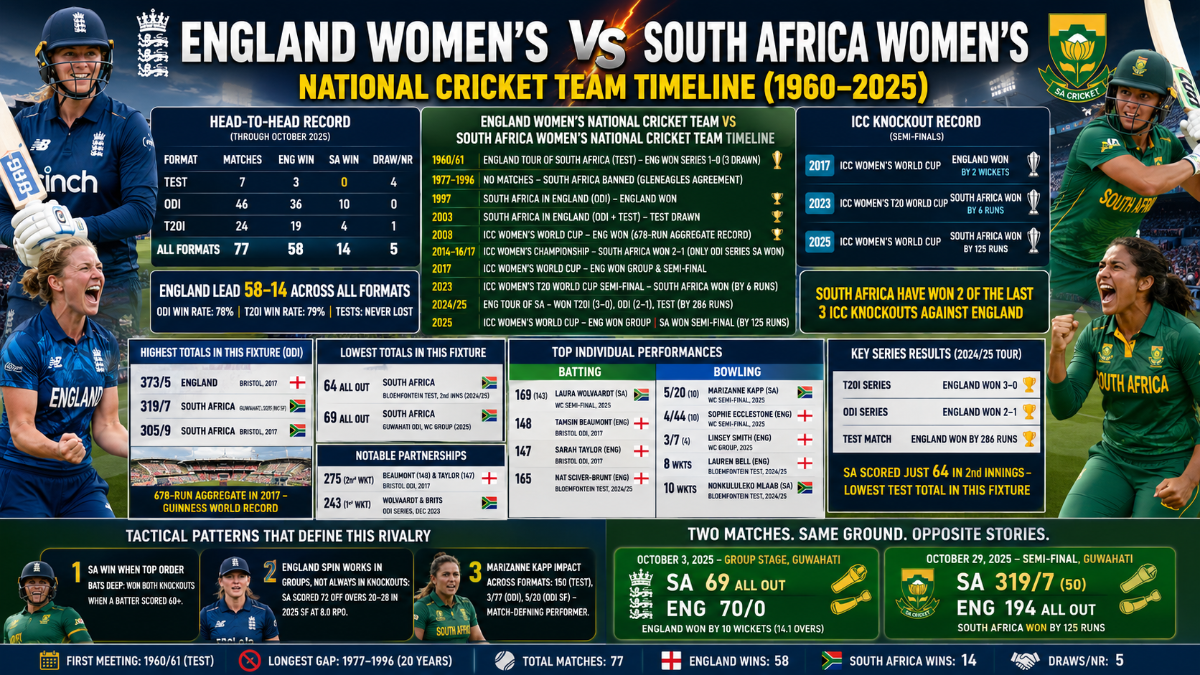
On October 3, 2025, England bowled South Africa out for 69 and chased the target in 14.1 overs without losing a wicket. Twenty-six days later, at the same tournament, South England Women’s National Cricket Team vs South Africa Women’s National Cricket Team Timeline: The Complete History, Records, and Analysis The England women’s national cricket team vs South Africa women’s national cricket team timeline spans more than six decades, evolving from a heavily one-sided colonial-era contest into one of the most closely watched rivalries in the modern women’s game. England hold a commanding overall advantage across all three formats of the sport, but South Africa’s dramatic improvement since 2020 has narrowed that gap considerably, producing genuine World Cup knockout drama as recently as July 2026 at The Oval. This comprehensive guide traces every major phase of the rivalry, breaks down the statistics by format, profiles the players who have defined each era, and explains the tactical shifts that have shaped recent results.
Head-to-Head Snapshot
England lead the all-format head-to-head against South Africa comfortably, winning close to 75 percent of completed ODIs and holding a similar advantage in T20I cricket. In Test matches, the two sides have met only seven times, with England winning three and four ending in draws, reflecting how infrequently women’s Test cricket has been scheduled between the two boards. Across ICC global tournaments specifically, England have won three of their last four knockout meetings against South Africa, a run that includes South Africa’s rare 2023 breakthrough and England’s consecutive revenge victories in 2025 and 2026. This makes the rivalry statistically lopsided in England’s favor on paper, even though South Africa have become significantly harder to beat over the past five years, particularly in shorter formats.
Why This Rivalry Matters in Women’s Cricket
Before diving into the numbers, it’s worth understanding why this particular fixture carries weight beyond a standard bilateral series. England and South Africa represent two very different cricketing pathways-England backed by a fully professional domestic structure since 2020, South Africa building depth through a smaller but increasingly competitive system centered on players who often also compete in franchise leagues abroad. Their meetings frequently double as barometers for where global women’s cricket stands, especially at ICC tournaments where knockout pressure exposes genuine gaps in squad depth.
Complete Rivalry Timeline: From 1960 to 2026
Understanding the England women’s national cricket team vs South Africa women’s national cricket team timeline requires tracing it through distinct eras, each shaped by different playing conditions, personnel changes, and shifts in tournament structure.
The Foundational Years (1960-1997)
South Africa’s women’s team first hosted England in 1960/61, contesting a four-match Test series that England won 1-0, with the remaining three matches ending in draws. This tour represented South Africa’s formal introduction to international women’s Test cricket. What followed was an unusually long gap in fixtures-South Africa’s political isolation during the apartheid era meant no officially recognized series took place for well over a decade, and the rivalry effectively went dormant through the 1970s and much of the 1980s. Bilateral cricket resumed only in 1997, when South Africa toured England and lost a tightly fought ODI series 2-1. This series matters historically because it marked South Africa’s re-entry into regular international competition after readmission to global cricket, setting the stage for the modern rivalry that followed.
Early Bilateral Dominance (2003–2014)
The modern, statistically rich phase of this rivalry began in 2003/04, when England toured South Africa and won the ODI series 4-1. This result set the tone for the next decade, establishing England as the clearly superior side across nearly every metric-batting depth, bowling variety, and fielding standards. England followed this with a 4-0 sweep during South Africa’s 2008 tour of England, a home series that further cemented their dominance. Through the early-to-mid 2010s, England continued winning bilateral T20I series comfortably, including 3-0 sweeps in both 2011/12 and 2014. During this stretch, South Africa’s batting lineup lacked the depth to compete consistently, often losing early wickets in the power play and never fully recovering against England’s more experienced attack.
Read More: United Arab Emirates National Cricket Team vs South Africa National Cricket Team Match Scorecard
The Competitive Shift (2017–2022)
This period marks the genuine turning point in the England women’s national cricket team vs South Africa women’s national cricket team timeline. England beat South Africa by 68 runs at Bristol during the 2017 ODI World Cup, a match that formed part of their eventual title-winning campaign on home soil. But behind that result, South Africa’s bowling attack-increasingly built around genuine pace options-began troubling England’s top order with greater regularity than in previous years. By 2022, South Africa were competitive enough to push England to the final over in several bilateral T20I fixtures, even though England still won the majority of completed matches. That year also saw England beat South Africa by 26 runs at the Commonwealth Games in Birmingham, notable as cricket’s return to the Commonwealth Games program after decades away.
The Knockout Era (2023–2026)
The most dramatic chapter of this rivalry arrived in February 2023, when South Africa stunned England by 6 runs in the T20 World Cup semi-final at Cape Town. This was South Africa’s first major ICC knockout win over England in the modern era and remains a landmark moment for South African women’s cricket, ending England’s semi-final run at that tournament in front of a home crowd. England responded emphatically during their 2024 tour of South Africa, sweeping the Only Test (won by 286 runs at Bloemfontein), winning two of three ODIs, and taking all three T20Is. This tour demonstrated England’s ability to bounce back decisively after a high-profile defeat, reasserting their dominance across formats within the same calendar year. The rivalry reached its latest flashpoint in July 2026, when England beat South Africa by 40 runs in the T20 World Cup semi-final at The Oval. This victory avenged both the 2023 semi-final loss and a 2025 ODI World Cup semi-final defeat, giving England a psychological edge heading into their T20 World Cup final appearance.
Head-to-Head Records by Format
England’s dominance is most pronounced in ODI cricket, where they have won roughly three out of every four completed matches against South Africa. The table below breaks down the complete format-wise statistical picture across the rivalry’s history.
| Format | Total Matches Played | England Wins | South Africa Wins | Draws/No Result | England Win % |
| Test | 7 | 3 | 0 | 4 | 43% |
| ODI | 46–48 | 35–36 | 10–11 | 1 | ~75% |
| T20I | 24–26 | 18–19 | 4–8 | 1 | ~70% |
South Africa’s T20I improvement is the standout trend in this table. Their win count in the shortest format has grown noticeably since 2020, even though England still hold a clear overall lead in every format measured.
Series-by-Series Breakdown
Beyond individual match results, series outcomes reveal how consistently one side has dominated entire tours rather than isolated games.
| Series | Year | Format | Result |
| England Women in South Africa | 1960/61 | Test | England won 1-0 (3 draws) |
| South Africa Women in England | 1997 | ODI | England won 2-1 |
| England Women in South Africa | 2003/04 | ODI | England won 4-1 |
| South Africa Women in England | 2008 | ODI | England won 4-0 |
| England Women in South Africa | 2011/12 | T20I | England won 3-0 |
| South Africa Women in England | 2014 | T20I | England won 3-0 |
| England Women in South Africa | 2020/21 | T20I | England won 2-1 |
| South Africa Women in England | 2022 | Test/ODI/T20I | England won all formats |
| England Women in South Africa | 2024/25 | Test/ODI/T20I | England won Test and 2 formats |
Every completed bilateral series since 2003 has ended in England’s favor, a run interrupted only by isolated match losses within otherwise England-dominated tours, underlining just how rarely South Africa have managed to win an entire series outright.
Biggest Wins and Closest Finishes
Some results in this rivalry stand out not just for the margin of victory but for the context in which they occurred.
- England’s biggest win overall: a 286-run Test victory at Bloemfontein in December 2024, their most emphatic result in any format against South Africa
- England’s biggest ODI margin: a 125-run win during the 2025 ODI World Cup, which doubled as revenge for an earlier semi-final defeat
- South Africa’s landmark win: a 6-run victory in the 2023 T20 World Cup semi-final at Cape Town, still regarded as South African women’s cricket’s biggest single triumph against England
- Closest historic finish: a narrow 2-wicket England win during a 2017 World Cup stage match, considered by many analysts as the moment the modern competitive era began
- Most recent result: England’s 40-run win in the 2026 T20 World Cup semi-final at The Oval, completing back-to-back semi-final revenge victories
Tactical Evolution of the Rivalry
The tactical balance of power has shifted gradually rather than suddenly, and understanding this evolution explains recent results better than any single match report. In the early 2000s and during the 2008 series, England’s advantage came almost entirely from batting depth-their top six routinely outscored South Africa’s by 50 to 80 runs per completed innings, largely due to superior domestic structures and player development pathways. By the mid-2010s, South Africa began closing that batting gap through improved player pathways, but their bowling attack still lacked the variety needed to trouble England’s most experienced batters in the crucial middle overs of an innings. That changed dramatically after 2020. South Africa’s pace bowling-led by genuinely quick, skiddy operators capable of extracting movement even on flatter pitches-started exploiting England’s top order early in matches. This pattern has appeared in nearly every recent meeting between the sides, including the 2026 semi-final, where England slipped to 23 for 3 inside the first six overs before recovering through disciplined batting.
Also Read: South Africa National Cricket Team vs West Indies Cricket Team Match Scorecard
England’s Recovery Method
England’s counter to this early pressure has consistently been partnership-building through patient batting rather than aggressive stroke play once early wickets fall. This method worked in the 2024 Test win at Bloemfontein, the 2025 ODI World Cup victory, and again during the 2026 semi-final, where Nat Sciver-Brunt and Heather Knight rebuilt through a 133-run partnership rather than attempting to force the pace immediately.
Why England Still Win More Often
Three measurable factors explain England’s continued statistical edge despite South Africa’s clear improvement over the past five years.
- Bowling rotation: England typically use five or more bowling options effectively across an innings rather than relying heavily on one or two frontline bowlers, spreading pressure evenly and denying opposition batters the chance to target a weak link
- Recovery method under pressure: England’s batting unit has repeatedly rebuilt from early collapses through disciplined, low-risk partnerships rather than panicked aggression, a pattern visible across multiple format types
- Knockout conversion rate: England have won three of their last four ICC tournament meetings against South Africa, suggesting stronger tactical composure specifically in high-pressure, single-elimination cricket compared to bilateral series cricket
Key Player Performances Across the Timeline
Certain individual performances have defined specific chapters of this rivalry and remain frequently referenced whenever the fixture is discussed.
| Player | Team | Notable Performance | Match Context |
| Sarah Taylor | England | 147 runs | 2017 ODI World Cup group stage |
| Marizanne Kapp | South Africa | 150 runs | 2022 Test at Taunton |
| Nat Sciver-Brunt | England | 169 not out | 2022 Test at Taunton |
| Nat Sciver-Brunt | England | 75 off 47 balls | 2026 T20 World Cup semi-final |
| Tazmin Brits | South Africa | Fighting half-century | 2026 T20 World Cup semi-final chase |
| Heather Knight | England | 58 runs | 2026 T20 World Cup semi-final |
| Laura Wolvaardt | South Africa | Consistent top-order returns | Multiple 2024–2026 fixtures |
Nat Sciver-Brunt has arguably become the single most influential player across the modern era of this rivalry, delivering match-defining performances in both Test and T20I formats against South Africa specifically. On South Africa’s side, the emergence of players like Tazmin Brits and Laura Wolvaardt as genuine top-order threats represents the batting depth South Africa clearly lacked a decade earlier.
The 2026 Semi-Final: The Latest Chapter in Detail
The most recent entry in the England women’s national cricket team vs South Africa women’s national cricket team timeline came at The Oval on July 2, 2026, during the T20 World Cup semi-final, and it deserves closer examination given its significance to the rivalry’s broader narrative. South Africa’s new-ball bowlers reduced England to 23 for 3 inside the first six overs, exploiting early movement on a pitch offering some assistance. Rather than attempting to accelerate immediately, Nat Sciver-Brunt and Heather Knight chose to rebuild deliberately, prioritizing partnership-building over aggressive stroke play. Their 133-run stand steadied the innings and eventually lifted England to a competitive 169 for 5 from their 20 overs. Chasing 170, South Africa’s Tazmin Brits provided genuine resistance with a fighting half-century, giving her side hope of a successful chase for large portions of the innings. However, once the required run rate climbed and South Africa lost wickets in clusters during the middle overs, their innings unraveled to 129 for 8, falling 40 runs short. This defeat meant South Africa failed to reach a fourth consecutive T20 World Cup final appearance, while England secured back-to-back semi-final revenge wins over South Africa-first at the 2025 ODI World Cup and now at the 2026 T20 World Cup.
What Makes South Africa Competitive Despite the Overall Gap
It would be inaccurate to characterize this rivalry as simply one-sided without acknowledging genuine structural improvements on South Africa’s side. Their fast bowling stocks have deepened considerably since 2020, producing multiple bowlers capable of consistently troubling England’s top order with genuine pace and skiddy bounce. Additionally, South Africa’s fielding standards have risen sharply, converting half-chances into wickets far more reliably than in earlier eras of this fixture. The primary remaining gap lies in middle-order batting depth during run chases-a pattern visible across the 2024 bilateral series, the 2025 World Cup defeat, and the 2026 semi-final collapse. South Africa’s top three batters have repeatedly performed well against England, but the transition from top order to middle order during pressure situations remains their most consistent statistical weakness in this specific rivalry.
Frequently Asked Questions:
Who has the better head-to-head record, England Women or South Africa Women?
England hold a clear overall lead, winning around 75 percent of completed ODIs and roughly 70 percent of T20Is played between the two sides since 2017, making this one of the more lopsided bilateral rivalries in the current women’s game.
When did England and South Africa women’s teams first play each other?
Their earliest recognized meeting was a Test series in 1960/61, hosted by South Africa, which England won 1-0 with the remaining three matches drawn.
Has South Africa Women ever beaten England Women in a World Cup knockout match?
Yes, South Africa won the 2023 T20 World Cup semi-final in Cape Town by 6 runs, their first major ICC knockout win over England in the modern era of the rivalry.
What happened in the 2026 T20 World Cup semi-final between England and South Africa?
England won by 40 runs at The Oval, recovering from an early collapse at 23 for 3 to post 169 for 5 before restricting South Africa to 129 for 8 in their chase.
What is England’s biggest win over South Africa in this rivalry?
Their largest margin victory came in the 2024 Test at Bloemfontein, won by 286 runs, making it the most emphatic result across any format in the entire rivalry.
How many Test matches have England and South Africa women played against each other?
Only seven Test matches have been played between the two sides across the entire rivalry, with England winning three and four ending in draws, reflecting how infrequently women’s Test cricket has been scheduled globally.
Why does South Africa struggle against England despite improving significantly in recent years?
South Africa’s batting has repeatedly struggled to build partnerships after early wicket losses against England’s bowling depth, a pattern visible across multiple recent matches including the 2024 tour, the 2025 World Cup, and the 2026 semi-final.
Who are the standout players in the England vs South Africa women’s rivalry?
Nat Sciver-Brunt for England, along with Marizanne Kapp, Tazmin Brits, and Laura Wolvaardt for South Africa, have been the most consistently influential performers across the last decade of this fixture.
How has South Africa’s T20I record against England improved over time?
South Africa’s T20I win count against England has grown steadily since 2020, narrowing what was once a heavily one-sided format-specific gap, largely due to improvements in their fast bowling depth.